
Is Pride and Prejudice a good book? Yes. Jane Austen’s most famous novel is not merely a respected classic that readers endure because it appears on school reading lists. It is witty, romantic, psychologically perceptive, and often genuinely funny. More than two centuries after its publication, the book remains one of the most entertaining introductions to classic English literature.
At first glance, Pride and Prejudice may appear to be a straightforward story about Elizabeth Bennet and Mr Darcy overcoming their mutual dislike and falling in love. That romantic development is important, but the novel is also concerned with social class, financial insecurity, family responsibility, reputation, marriage, and the dangerous confidence people place in their first impressions.
Austen builds the story through conversations, visits, dances, letters, embarrassing relatives, and apparently minor social encounters. There are no battles, supernatural threats, murder investigations, or journeys across continents. Nevertheless, the novel rarely feels empty because almost every exchange reveals something about a character’s intelligence, vanity, insecurity, prejudice, or hidden motivation.
The book will not appeal equally to everyone. Readers who need constant action, explicit romance, or dramatic external conflict may find its pace restrained. Its sentence structures and social conventions also require some adjustment. However, readers who appreciate clever dialogue, flawed protagonists, gradual emotional development, and social satire are likely to understand why Pride and Prejudice is still worth reading.
Is Pride and Prejudice Worth Reading?
The Short Answer
Pride and Prejudice is absolutely worth reading, particularly for readers interested in character-driven stories, intelligent romance, and classic novels that balance literary depth with entertainment.
Its strongest quality is the way Jane Austen combines several different pleasures without allowing any one of them to overwhelm the others. The novel is romantic without becoming sentimental, humorous without becoming meaningless, and socially observant without turning into a lecture. Elizabeth and Darcy’s relationship gives the book its emotional center, but its family dynamics and supporting characters make the entire social world memorable.
It is also more accessible than its reputation sometimes suggests. The language is older and occasionally formal, but it is far less intimidating than many long philosophical, experimental, or heavily descriptive classics. Once readers become comfortable with the names, relationships, and social rules, the plot becomes easy to follow.
Pride and Prejudice Quick Review
- Best qualities: witty dialogue, memorable characters, social satire, romantic tension, humor, and convincing personal growth.
- Possible difficulties: historical language, restrained action, unfamiliar social conventions, and an initially slow pace.
- Best for: readers who enjoy intelligent romance, flawed protagonists, family drama, and subtle comedy.
- Not ideal for: readers seeking action, explicit romance, fantasy, danger, or an extremely fast plot.
- Reading difficulty: moderate at first, but generally approachable after the opening chapters.
- Overall verdict: one of the most enjoyable, influential, and accessible major novels in English literature.
What Is Pride and Prejudice About?
Pride and Prejudice follows the Bennet family, particularly Elizabeth Bennet, the intelligent and outspoken second of five daughters. The Bennets live at Longbourn, an estate that the daughters cannot inherit. Because the property is legally destined to pass to a male relative, the family’s financial future is uncertain.
This situation helps explain why Mrs Bennet is obsessed with finding suitable husbands for her daughters. Her behavior is frequently foolish, noisy, and embarrassing, but the anxiety beneath it is not entirely irrational. Without advantageous marriages, the Bennet sisters could eventually face a serious decline in their standard of living.
The story begins when the wealthy and friendly Mr Bingley rents Netherfield Park, a nearby estate. Mrs Bennet immediately hopes that he will marry one of her daughters. Bingley soon becomes interested in Jane Bennet, the eldest sister, whose kindness and beauty make her widely admired.
Bingley arrives in the neighborhood with his friend Mr Darcy, a considerably wealthier man whose proud and reserved behavior quickly creates a poor impression. Elizabeth hears Darcy dismiss her as an unsuitable dancing partner and decides that he is arrogant, unpleasant, and excessively conscious of his social rank.
From this uncomfortable beginning, Elizabeth and Darcy repeatedly encounter one another. Their conversations are sharp, defensive, and intellectually energetic. Elizabeth believes she understands Darcy’s character, while Darcy gradually becomes attracted to the very woman who challenges his pride and refuses to flatter him.
The novel’s plot develops through mistaken judgments, romantic misunderstandings, family scandals, proposals, refusals, letters, and changes of perspective. Although the relationship between Elizabeth and Darcy is central, the book is also a broader examination of how people choose partners and how badly those choices can go when they are controlled by money, beauty, impulse, social ambition, or self-deception.
The Bennet Family and the Problem of Longbourn
Understanding the Bennets’ financial situation is essential to understanding the novel. Longbourn is entailed away from the five daughters, which means that after Mr Bennet’s death, the estate will pass to Mr Collins, a distant male cousin.
The Bennet women may continue to possess some money, but they will lose the home and income associated with Longbourn. This possibility gives marriage an economic importance that can seem uncomfortable to modern readers. For women of the Bennet sisters’ social position, respectable professional opportunities were extremely limited. A good marriage could provide security, while remaining unmarried could mean dependence on relatives.
Austen does not present this reality as a reason women should accept any available husband. Elizabeth repeatedly insists that respect and affection matter. At the same time, the novel refuses to pretend that every woman has the luxury of ignoring financial consequences.
Elizabeth Bennet and Mr Darcy
Elizabeth and Darcy are compelling because neither begins the novel ready for a healthy relationship.
Elizabeth is intelligent, lively, and unusually willing to speak her mind. She dislikes pretension and is quick to notice absurd behavior. However, she also enjoys laughing at people and becomes overly confident in her ability to judge them. Once she decides that Darcy is proud and Wickham is trustworthy, she interprets new information in ways that support those conclusions.
Darcy is principled, loyal, and capable of generosity, but he is also socially proud, emotionally guarded, and insufficiently aware of how insulting his behavior can appear. His wealth and rank have allowed him to expect consideration without always offering equal consideration to others.
Their relationship works because the novel does not ask one person to remain perfect while the other changes completely. Both must recognize painful truths about themselves. Their romance is therefore not simply a reward for physical attraction. It becomes possible only after moral and emotional growth.
Why Is Pride and Prejudice Considered a Great Book?
Elizabeth Bennet Is Intelligent, Funny, and Imperfect
Elizabeth Bennet is one of the most enduring protagonists in classic literature because she combines admirable independence with believable flaws.
She is intelligent without being impossibly knowledgeable, confident without always being correct, and rebellious without existing completely outside the values of her society. Elizabeth refuses to marry merely because a proposal is financially convenient. She wants respect, affection, and intellectual compatibility, even though her family’s circumstances make such standards risky.
Her humor is one of the novel’s greatest pleasures. Elizabeth often sees the ridiculous side of social rituals and foolish personalities. She can identify vanity, hypocrisy, and bad manners quickly. Yet this ability also contributes to her mistakes. Because she is frequently correct about other people’s absurdities, she becomes less likely to question herself when she is wrong.
Elizabeth is not a flawless modern heroine placed artificially inside an old-fashioned world. She is shaped by her family, her social class, her limited information, and her own emotional preferences. Her development becomes meaningful because she must admit that intelligence alone has not protected her from prejudice.
Mr Darcy Must Earn the Reader’s Respect
Mr Darcy is often remembered as a romantic ideal, but his appeal should not be reduced to wealth, appearance, or social status.
At the beginning of the novel, Darcy is genuinely unpleasant in several situations. His reserve can become contempt, his awareness of social difference becomes arrogance, and his honesty lacks generosity. Austen does not ask readers to excuse this behavior simply because he later becomes a romantic hero.
What makes Darcy interesting is his capacity to listen, reflect, and change. When Elizabeth criticizes him, he does not immediately become charming or defend every action. Instead, he gradually examines whether her accusations contain truth.
His growth is demonstrated through behavior rather than grand speeches. He becomes more considerate toward people he previously dismissed. He assists others without demanding public gratitude. He respects Elizabeth’s refusal and recognizes that affection cannot be separated from the way he treats her family.
This development distinguishes him from a fantasy hero who is secretly perfect from the beginning. Darcy must become more worthy of Elizabeth, just as Elizabeth must become more capable of understanding him.
The Dialogue Is Exceptionally Witty
Jane Austen’s dialogue gives the novel much of its speed and personality. Characters reveal themselves through the way they speak, interrupt, flatter, complain, evade questions, or misunderstand one another.
Elizabeth and Darcy’s conversations are especially memorable because neither is passive. Their exchanges contain attraction, irritation, curiosity, competition, and defensiveness. Even when they are discussing ordinary subjects, they are testing each other’s intelligence and character.
The comic characters are equally distinctive. Mr Collins speaks with exhausting self-importance and rarely recognizes the effect he has on other people. Mrs Bennet moves rapidly between triumph and despair. Lady Catherine de Bourgh treats her opinions as unquestionable laws. Mr Bennet uses sarcasm to protect himself from domestic frustration, even when his jokes fail to solve the problems around him.
Austen rarely needs long descriptions to explain that a character is foolish. She simply allows that character to keep talking.
The Supporting Characters Make the Social World Feel Alive
Although Elizabeth and Darcy dominate popular discussions of the novel, the supporting characters are essential to its meaning.
Jane Bennet and Mr Bingley represent a gentler romantic relationship. Both are kind, attractive, and inclined to think well of others. Their goodness is genuine, though Jane’s reluctance to display strong emotion creates misunderstandings.
Charlotte Lucas offers one of the novel’s most important alternative perspectives. She is practical, intelligent, and aware that her opportunities are limited. Her decisions may disappoint Elizabeth, but they cannot be dismissed as simple foolishness. Charlotte understands marriage partly as an economic arrangement and chooses security rather than waiting for an unlikely ideal.
Lydia Bennet represents impulse without reflection. She is energetic and confident but fails to understand how seriously her behavior can affect both herself and her sisters.
George Wickham demonstrates the danger of charm without integrity. He knows how to tell a convincing story and how to appear open, friendly, and injured. His social ease makes him more immediately likable than Darcy, illustrating how easily good manners can be mistaken for good character.
Mr and Mrs Bennet also provide a warning about marriage. Their relationship was formed through attraction rather than compatibility. Years later, they respond to disappointment in destructive ways: Mrs Bennet through noise and anxiety, Mr Bennet through withdrawal and mockery.
These different relationships turn the novel into more than one love story. They create a social experiment in which readers observe what happens when people choose partners for affection, appearance, money, convenience, impulse, or status.
The Characters Change in Meaningful Ways
Many romantic stories create obstacles outside the couple: rival suitors, family feuds, distance, war, or bad luck. In Pride and Prejudice, the greatest obstacles are partly internal.
Elizabeth and Darcy misunderstand one another because they are both attached to flattering versions of themselves. Elizabeth sees herself as an excellent judge of character. Darcy sees himself as honorable enough that his manners should not matter greatly.
For the relationship to succeed, each must experience embarrassment. Elizabeth must recognize that she has been manipulated by appearances. Darcy must recognize that good intentions do not erase arrogance.
The emotional satisfaction of the ending depends on this mutual development. They do not simply discover that they were secretly compatible all along. They become more compatible by learning from failure.
Is Pride and Prejudice Just a Romance Novel?
Pride and Prejudice is certainly a romance novel. The developing relationship between Elizabeth Bennet and Mr Darcy provides its main emotional arc, and the eventual resolution of their conflict is central to the book’s appeal.
However, describing it as “just a romance” misses much of what makes it enduring. It is also a comedy of manners, a family drama, a social satire, and a novel about moral education. Austen uses courtship to investigate wider questions about wealth, class, reputation, personality, and power.
Marriage was one of the most consequential choices available to women in the social world Austen depicts. A romantic decision could determine a woman’s financial stability, home, independence, and social position. For that reason, the novel’s marriages are never purely private matters.
Why the Romance Still Works
The romance between Elizabeth and Darcy remains effective because it develops through tension, observation, and changing judgment rather than immediate idealization.
Elizabeth does not admire Darcy because everyone else says she should. Darcy cannot win her affection by presenting his wealth or family name. Their attraction becomes connected to intellectual respect and moral behavior.
Much of their chemistry appears in conversations where each challenges the other. Elizabeth refuses to become submissive in Darcy’s presence, while Darcy becomes fascinated by her refusal to perform the admiration he usually receives.
The romance also benefits from restraint. Because Austen does not explain every feeling directly, readers must pay attention to gestures, silences, letters, and changes in behavior. The emotional development can therefore feel more participatory: readers interpret the relationship alongside the characters.
How It Differs from Modern Romance Novels
Readers accustomed to contemporary romance should expect a different experience. Elizabeth and Darcy spend relatively little private time together. Physical intimacy is almost absent, and emotional declarations are limited by social rules.
The relationship develops through public encounters, family visits, formal conversations, dances, letters, and observations of how each person behaves toward others. Austen is interested in whether attraction can mature into respect, not in providing continuous scenes of romantic intimacy.
The stakes are also shaped by reputation and marriageability. A careless decision can affect an entire family, particularly its unmarried daughters. These pressures may seem excessive from a modern perspective, but they explain why small social events carry enormous emotional weight.
Why Calling It “Enemies to Lovers” Is Only Partly Accurate
Pride and Prejudice is frequently described as an early example of the enemies-to-lovers trope. The phrase is understandable, but it is not entirely precise.
Elizabeth and Darcy are not true enemies. They are socially connected acquaintances who dislike and misunderstand one another. Darcy’s pride, Elizabeth’s resentment, differences in class, and inaccurate information create hostility.
Their story is therefore closer to “mistaken first impressions to mutual understanding.” Attraction exists before complete respect, but love becomes possible only after both characters reevaluate what they think they know.
What Are the Main Themes of Pride and Prejudice?
Pride, Prejudice, and First Impressions
The title identifies the novel’s most famous themes, but pride and prejudice are not assigned neatly to one character each.
Darcy is obviously proud. He is conscious of his rank, family connections, and wealth. He initially behaves as though many people around him are beneath his notice.
Elizabeth is obviously prejudiced against him, particularly after hearing his insulting remark and listening to Wickham’s account of their history. Yet Elizabeth also possesses pride. She takes satisfaction in her intelligence and believes that she sees through people more clearly than others do.
Darcy also possesses prejudice. He judges Elizabeth’s family through class expectations and allows their behavior to influence his view of her suitability.
The novel therefore resists a simple division in which one person represents pride and the other prejudice. Both qualities distort both characters’ judgments.
Marriage for Love or Financial Security
Marriage in Pride and Prejudice is simultaneously romantic, social, and economic.
Elizabeth wants a marriage based on respect and affection. Jane and Bingley offer a more immediately harmonious version of romantic love. Charlotte Lucas chooses security and independence from her family home. Lydia pursues excitement without understanding consequences. Mr and Mrs Bennet reveal what can happen when attraction is not supported by respect or compatibility.
Austen does not offer a simplistic moral in which marrying for love guarantees happiness while considering money makes a character corrupt. Financial security matters, especially for women with limited legal and professional independence.
The novel instead asks whether financial necessity can be balanced with self-respect. Charlotte’s decision is understandable even when it is not desirable. Elizabeth’s refusal of an advantageous proposal is admirable, but it is also risky.
Class, Wealth, and Social Status
Class influences nearly every important relationship in the novel.
Darcy’s social position encourages him to evaluate the Bennets as an unsuitable family. Lady Catherine assumes that rank gives her authority over the choices of other people. Caroline Bingley uses fashionable behavior to establish superiority, even when her conduct is less generous than Elizabeth’s.
At the same time, Austen does not portray all wealthy characters as cruel or all less wealthy characters as virtuous. Darcy becomes capable of humility and generosity. Wickham’s lower financial position does not excuse his dishonesty. Mr Collins’s dependence on patronage does not make him sympathetic.
The criticism is directed less at wealth itself than at the belief that wealth proves moral worth.
Women, Property, and Limited Choices
The female characters live within a system that severely restricts their independence.
The Bennet daughters cannot inherit Longbourn. Their mother has little power to secure their future except by encouraging marriage. Respectable paid employment is limited, and remaining single often means financial dependence on relatives.
These restrictions make personal choice both important and difficult. Elizabeth’s refusal to marry without affection is a declaration of self-respect, but Austen does not pretend that every woman can afford to make the same choice.
Charlotte Lucas is particularly important because she exposes the limitations of romantic judgment. Elizabeth initially evaluates Charlotte’s marriage according to her own preferences. Charlotte evaluates it according to her age, financial prospects, and desire for a stable household.
The novel’s treatment of women is therefore neither a simple celebration of complete independence nor a defense of social convention. It reveals how women attempt to make meaningful choices within a structure they did not create.
Reputation and Family Responsibility
Individual behavior in the novel has collective consequences.
The Bennet sisters’ marriage prospects are influenced by the conduct of their parents and siblings. Mrs Bennet’s public desperation, Lydia’s recklessness, Kitty’s imitation of Lydia, and Mr Bennet’s failure to exercise responsible authority all affect the family’s reputation.
This social system is unfair, particularly to women. A young woman’s mistake can damage not only her own future but also that of her sisters. Men often possess greater freedom to recover from similar behavior.
Austen criticizes irresponsible conduct while also showing how harshly society punishes women for it.
Self-Knowledge and Moral Growth
The deepest theme in Pride and Prejudice may be self-knowledge.
Elizabeth and Darcy are intelligent people, but intelligence does not automatically create wisdom. Both are skilled at identifying flaws in others and less prepared to recognize their own.
The novel suggests that maturity requires more than holding strong principles. It requires the ability to revise one’s beliefs when new evidence appears.
Elizabeth’s most important discovery is not that Darcy is better than she expected. It is that her own judgment is less reliable than she believed. Darcy’s most important discovery is not simply that Elizabeth is worthy of him. It is that his behavior has often been unworthy of the standards he claims to value.
How Jane Austen’s Writing Style Makes the Book Special
Irony and Social Satire
Jane Austen’s irony allows the novel to criticize social behavior without becoming heavy or preachy.
Characters often reveal the opposite of what they intend. Mr Collins believes his speeches demonstrate dignity, intelligence, and refinement. Instead, they reveal vanity and dependence. Lady Catherine assumes that speaking forcefully proves wisdom. Her confidence exposes entitlement.
Mrs Bennet considers herself a devoted mother, but her efforts frequently embarrass the daughters she hopes to help. Mr Bennet considers himself more intelligent than his wife, yet his sarcasm often replaces responsible action.
The humor can be understated. Austen does not always signal a joke clearly. A sentence may appear polite while quietly exposing hypocrisy or foolishness. Readers who pay attention to contradictions are rewarded.
This use of humor connects Austen with other enduring satirical classics. Readers who enjoy novels that expose human self-deception through comedy may also appreciate our discussion of whether Don Quixote is a good book. Cervantes and Austen write in very different styles, but both understand that people can become funniest when they are most certain of their own wisdom.
Free Indirect Discourse
One of Austen’s most important techniques is free indirect discourse. The term can sound technical, but the effect is easy to understand.
The narrator speaks in the third person, yet the language often moves close to Elizabeth’s thoughts. Readers experience events through her assumptions without every sentence being marked with phrases such as “Elizabeth thought” or “Elizabeth believed.”
This creates intimacy, but it also creates a trap. Because Elizabeth is intelligent and entertaining, readers are encouraged to trust her interpretations. When she judges Darcy or believes Wickham, her confidence can become the reader’s confidence.
As Elizabeth discovers her mistakes, readers may realize that they also accepted incomplete evidence. The narrative technique therefore turns the theme of prejudice into a reading experience.
Characterization Through Dialogue
Austen often characterizes people through speech rather than description.
Mr Collins’s long, formal compliments reveal insecurity and self-importance. Lydia’s excited conversation reveals her lack of restraint. Jane’s careful language reveals her generosity and reluctance to judge. Darcy’s early brevity reinforces his social discomfort and pride.
Elizabeth’s speech is lively and flexible. She jokes, challenges, questions, and sometimes provokes. Her conversations with Darcy are appealing because each person recognizes the other’s intelligence, even before they understand each other’s character.
This emphasis on dialogue makes the novel particularly enjoyable for readers who like social tension. A visit, dinner, dance, or proposal can become dramatic because the words spoken are only part of what is being communicated.
A Small World with Remarkable Psychological Detail
The novel’s geographical and social world is relatively small. Much of the action occurs in homes, drawing rooms, gardens, villages, and assembly rooms.
For some readers, this narrow focus may feel limiting. Major political and historical events remain distant. The lives of working-class characters receive little attention, and the story primarily examines families connected to the landed gentry.
However, Austen uses this limited space with extraordinary precision. A small social circle becomes a laboratory for pride, embarrassment, attraction, envy, insecurity, and competition.
The lack of physical adventure does not mean that nothing happens. The adventure is interpretive: characters try to determine who can be trusted, who is sincere, and whether they understand themselves.
Is Pride and Prejudice Hard to Read?
Is Pride and Prejudice hard to read? It can be moderately challenging during the opening chapters, especially for readers who are unfamiliar with nineteenth-century English novels. However, it is generally easier than many famous classics.
The story is not difficult because its ideas are incomprehensible. The main challenges are historical language, long sentence structures, unfamiliar social rules, and the number of names introduced early.
Once readers understand the Bennet family, the Bingleys, Darcy, Mr Collins, and the main locations, the narrative becomes much clearer.
Is the Language Difficult?
The language is formal compared with contemporary fiction, but it is not Old English or Middle English. Austen wrote in a form of English that remains recognizable to modern readers.
Some sentences are longer than readers may expect, and certain words have changed in meaning. Characters also communicate indirectly because politeness and social restraint prevent them from speaking with complete openness.
A good annotated edition can explain historical vocabulary and customs without interrupting the story excessively.
Why the First Chapters Can Feel Slow
The first chapters introduce several families, financial situations, social expectations, and marriage prospects. Readers may initially feel that the book contains too many visits, dances, and discussions.
These scenes establish the social rules that make later events meaningful. Who dances with whom, who visits first, who receives an invitation, and how publicly someone displays romantic interest can affect reputation and interpretation.
The pace also improves once the central relationships and conflicts are established. Readers who reach the major proposals and letters often find the second half much more difficult to put down.
Understanding Jane Austen’s Humor
Austen’s humor is frequently dry. The narrator may describe ridiculous behavior in perfectly calm language. Characters may appear serious while the reader is expected to recognize that they are being absurd.
Readers should therefore be suspicious of exaggerated compliments, confident moral statements, and characters who praise their own sensitivity or intelligence.
Reading slowly can reveal jokes that disappear when the novel is rushed.
Tips for Reading Pride and Prejudice for the First Time
- Use an edition with short historical notes. Explanations of inheritance, money, and social customs can make the characters’ choices much clearer.
- Keep track of the main families. A simple list of the Bennets, Bingleys, Lucases, and Darcys can prevent early confusion.
- Read dialogue carefully. Characters frequently communicate through implication rather than direct statements.
- Do not assume Elizabeth is always correct. She is the protagonist, but the novel deliberately allows her to make mistakes.
- Give the social world time to develop. The early dances, visits, and conversations establish conflicts that become important later.
- Avoid searching for characters online. Even basic descriptions can reveal major developments.
- Consider reading a chapter at a time. The novel’s chapters are manageable and often end with a new social or emotional complication.
What Are the Weaknesses of Pride and Prejudice?
A balanced Pride and Prejudice review should acknowledge that even a great novel may frustrate certain readers.
Many of its supposed weaknesses are connected to deliberate artistic choices. Nevertheless, a choice can be effective and still fail to satisfy every audience.
The Plot Is Driven More by Conversations Than Action
The story advances primarily through social encounters, letters, proposals, rumors, and changes in understanding.
Readers seeking danger, travel, physical conflict, or constant plot twists may find the novel uneventful. Even major crises are often communicated through conversations or correspondence rather than shown as dramatic action scenes.
For readers interested in psychology and social behavior, this is a strength. For action-oriented readers, it may be the greatest obstacle.
The Social World Can Feel Narrow
The novel focuses on a limited section of English society. The concerns of the landed gentry and socially respectable families dominate the narrative.
Working-class life, colonial wealth, national politics, and broader economic structures remain mostly outside the frame. Modern readers may reasonably wish that the social critique extended further.
However, Austen’s precision partly depends on concentrating on a world she understood closely. The narrow setting allows for unusually detailed observation of manners and relationships.
The Romance Is Emotionally Restrained
Readers who expect constant expressions of desire may find Elizabeth and Darcy’s relationship distant.
Their feelings are revealed indirectly through changes in tone, acts of consideration, embarrassment, reflection, and the way they respond to one another’s criticism.
This restraint creates subtlety, but it also means that some readers may feel the couple spends too little time together. Adaptations often add visual intensity and private moments because the novel’s emotional life is difficult to translate directly onto the screen.
Some Characters Are Deliberately Exaggerated
Mr Collins, Mrs Bennet, and Lady Catherine can resemble comic caricatures. Their most ridiculous qualities appear repeatedly, and they rarely develop the complexity given to Elizabeth or Darcy.
This exaggeration strengthens the comedy and allows Austen to expose vanity and social ambition quickly. However, readers who prefer every character to be psychologically balanced may find these figures too broad.
Historical Context Matters
Without understanding inheritance, reputation, and women’s limited economic options, many of the characters’ concerns can appear trivial.
Mrs Bennet’s obsession with marriage may look ridiculous without the recognition that her daughters’ future home and income are genuinely insecure. Charlotte Lucas’s decision may appear cold without awareness of the limited alternatives available to her.
The novel can still be enjoyed without extensive historical knowledge, but context makes it richer and prevents modern assumptions from flattening its conflicts.
Who Should Read Pride and Prejudice?
Pride and Prejudice is worth reading for people who enjoy stories in which personality, language, and interpretation matter more than physical action.
- Readers interested in classic romance.
- Readers who enjoy witty dialogue and understated humor.
- Readers who prefer character development to action-heavy plots.
- Fans of social satire and flawed protagonists.
- Readers interested in family relationships and social embarrassment.
- People curious about women, marriage, class, and property in Regency England.
- Readers looking for an approachable introduction to Jane Austen.
- Fans of slow-burn romantic tension.
- Readers who enjoy stories about mistaken impressions and moral growth.
Who May Not Enjoy Pride and Prejudice?
- Readers who require constant action or danger.
- Readers looking for explicit or highly physical romance.
- Readers uninterested in conversations, manners, and family relationships.
- Readers unwilling to adjust to historical language and customs.
- Readers who prefer extensive world-building or large-scale political plots.
- Readers who dislike protagonists capable of making serious errors in judgment.
Is Pride and Prejudice a Good First Classic?
Pride and Prejudice is a good first classic because it offers literary sophistication without demanding extreme patience or specialized knowledge.
Its length is manageable, its central conflict is easy to understand, and its characters remain emotionally recognizable. Even readers who know little about Regency England can understand family embarrassment, romantic disappointment, social insecurity, and the discomfort of realizing that a confident opinion was wrong.
The novel also provides a useful introduction to several techniques common in classic literature: social satire, indirect characterization, an intrusive or ironic narrator, and themes that develop through contrasting characters.
How It Compares with More Demanding Classics
Compared with many nineteenth-century novels, Pride and Prejudice is relatively concise. It does not contain enormous philosophical digressions, multiple generations of family history, or hundreds of pages of political background.
Its challenge lies in subtlety rather than size. Readers must notice tone, implication, and changing perspective.
Those who want a very different kind of classic may prefer a novel driven by adventure, imprisonment, revenge, and dramatic reversals. Our review asking whether The Count of Monte Cristo is a good book examines a much longer and more action-oriented reading experience.
Pride and Prejudice, by contrast, demonstrates that a dance or dinner conversation can carry as much tension as a duel when reputation and emotion are involved.
Is It a Good First Jane Austen Novel?
For most readers, Pride and Prejudice is an excellent first Jane Austen novel.
It contains many of her most recognizable qualities: intelligent heroines, social comedy, romantic misjudgment, family pressure, and sharp observations about class and marriage.
Readers who enjoy it can continue with Sense and Sensibility for a contrast between emotional restraint and romantic impulsiveness, Emma for another intelligent heroine whose judgment fails her, or Persuasion for a quieter and more mature story about regret and second chances.
Why Is Pride and Prejudice Still Popular?
Elizabeth and Darcy Remain Compelling
Elizabeth and Darcy remain popular because their relationship combines fantasy with psychological credibility.
Darcy possesses wealth and social power, but those qualities do not automatically make him desirable. Elizabeth’s refusal forces the story to ask whether he can become more considerate and self-aware.
Elizabeth is independent and clever, but the novel does not reward her simply for being outspoken. She must confront her own vanity and the pleasure she takes in believing herself correct.
Their romance therefore appeals to readers who want attraction to be accompanied by respect and growth.
The Book Combines Literary Depth with Entertainment
Some classics are admired more often than they are enjoyed. Pride and Prejudice survives partly because it succeeds at both.
It can be studied for its narrative technique, historical context, gender politics, and social criticism. It can also be read simply because Elizabeth is entertaining, Darcy is intriguing, Mr Collins is absurd, and the romantic tension is satisfying.
The novel does not force readers to choose between intellectual interest and emotional pleasure.
Its Conflicts Still Feel Familiar
The social structures of Austen’s world have changed, but many of the emotional conflicts remain recognizable.
People still make judgments based on appearance, wealth, reputation, family background, confidence, and charm. They still confuse social ease with goodness and reserve with arrogance. They still feel embarrassed by relatives and fear that other people’s behavior will reflect on them.
The novel’s central question remains modern: what happens when a person discovers that a deeply held opinion was formed by pride, incomplete information, or personal preference?
Adaptations Have Introduced the Story to New Generations
Pride and Prejudice has inspired numerous stage, television, and film adaptations. Some preserve the historical setting, while others transfer the basic structure to different cultures and periods.
Visual adaptations make the romance immediately accessible through performance, costume, music, facial expression, and landscape. They can also help readers understand the social world before approaching the novel.
However, adaptations often struggle to preserve Austen’s narrative irony. A camera can show Elizabeth’s expression, but it cannot easily reproduce the subtle way the narrator enters her assumptions and leads readers toward mistaken conclusions.
The continued popularity of these adaptations demonstrates the flexibility of the story. Elizabeth and Darcy’s conflict can survive changes in fashion and setting because it is based on recognizable problems of judgment, attraction, and self-respect.
What Can Modern Readers Learn from Pride and Prejudice?
The novel remains valuable not because it offers a simple moral lesson, but because it shows how intelligent people rationalize errors.
- Confidence is not the same as accurate judgment. Elizabeth’s certainty makes her mistakes more convincing, not less significant.
- Intelligence does not eliminate bias. Clever people can become skilled at defending conclusions they already prefer.
- Real change must be demonstrated through behavior. Darcy’s development matters because it affects how he treats people.
- Attraction alone does not create a healthy relationship. Respect, responsibility, and self-knowledge are equally important.
- Social status can distort moral judgment. Wealth may create admiration that a person’s conduct has not earned.
- Charm is not proof of integrity. Friendly behavior can conceal selfish intentions.
- Admitting an error is a form of maturity. Elizabeth and Darcy improve because they allow embarrassment to teach them something.
- Family environments influence personal choices. The Bennet sisters respond differently to the same parents and pressures.
- Financial circumstances affect romantic freedom. Not everyone possesses equal freedom to wait for an ideal relationship.
Frequently Asked Questions About Pride and Prejudice
Is Pride and Prejudice Boring?
Pride and Prejudice can feel boring to readers who expect action, danger, or constant changes in location. Much of the drama is social and psychological.
For readers who enjoy dialogue, romantic tension, embarrassing families, and subtle humor, the novel is often surprisingly lively.
The opening chapters may require patience because Austen is establishing relationships and social expectations. Once the misunderstandings deepen, the pace usually feels faster.
Is Pride and Prejudice Appropriate for Teenagers?
Yes. Pride and Prejudice is generally appropriate for teenagers. It contains romantic conflict, family pressure, and discussions of reputation, but no explicit sexual content or graphic violence.
Younger readers may need help understanding inheritance, marriage expectations, and the social consequences of certain decisions. An annotated edition or classroom discussion can make the novel more accessible.
Is Pride and Prejudice a Feminist Novel?
The answer depends on how feminism is defined.
The novel strongly values Elizabeth’s intelligence, judgment, and right to refuse unwanted marriage. It exposes the financial dependence created by inheritance laws and limited opportunities for women. It also presents several women attempting to exercise choice within restrictive circumstances.
However, the novel does not imagine a complete rejection of marriage or social hierarchy. Its heroines seek better choices within their world rather than escaping that world entirely.
It is therefore reasonable to describe Pride and Prejudice as a novel with significant feminist concerns, while recognizing that it remains connected to the social assumptions of its period.
Is Pride and Prejudice Really Romantic?
Yes, but its romance is emotionally restrained.
The novel focuses on attraction, respect, misunderstanding, moral change, and the possibility of a compatible marriage. Physical intimacy is almost absent.
Readers who define romance through emotional development and gradual trust may find it deeply romantic. Readers who expect explicit desire or frequent private scenes may find it distant.
Is the Pride and Prejudice Book Better Than the Movies?
The novel offers more psychological detail, narrative irony, and access to Elizabeth’s changing perceptions. It also provides a richer understanding of the supporting characters and social context.
Film and television adaptations can make the romance more visually immediate. Performances, music, costume, and landscape may intensify feelings that Austen expresses indirectly.
The book is generally the more complete experience, but a strong adaptation can be an excellent introduction.
Should You Watch an Adaptation Before Reading the Book?
Reading the novel first allows Austen’s revelations and changes of perspective to have their full effect.
However, readers intimidated by the setting may benefit from watching an adaptation first. Seeing the families, houses, dances, and social customs can reduce confusion.
The main disadvantage is that adaptations may reveal character developments and romantic outcomes before the book can build them gradually.
Does Pride and Prejudice Have a Happy Ending?
The novel is structured as a romantic comedy and ultimately moves toward emotional and social resolution. Readers who are worried that the story will end in complete tragedy can approach it without that fear.
Nevertheless, the exact path to that resolution should be experienced through the novel rather than summarized in advance.
Is Pride and Prejudice Based on a True Story?
No. Pride and Prejudice is a work of fiction. However, Jane Austen drew upon social environments, family relationships, courtship practices, and financial pressures that she understood closely.
The characters are fictional, but the social limitations they face reflect real features of English life during Austen’s period.
Final Verdict: Is Pride and Prejudice a Good Book?
Is Pride and Prejudice a good book? Yes. It is an excellent novel and one of the rare classics that combines historical importance with immediate entertainment.
Jane Austen creates a convincing romance without allowing love to excuse arrogance, carelessness, or poor judgment. Elizabeth Bennet and Mr Darcy are attractive not because they are perfect, but because they are capable of recognizing their failures and changing their behavior.
The book’s greatest strengths are its dialogue, irony, characterization, and ability to transform small social situations into meaningful emotional conflicts. A proposal, dance, visit, or letter can alter the reader’s understanding of several characters at once.
Its limitations should still be acknowledged. The plot is restrained, the social world is narrow, and the historical language may slow new readers. Those seeking action or explicit romance may struggle to understand its reputation.
For readers who enjoy intelligent characters, family comedy, social criticism, and slow-burn romantic development, Pride and Prejudice is absolutely worth reading.
It is also a strong first classic because it demonstrates that literary sophistication does not require abandoning pleasure. The novel can make readers think carefully about class, money, gender, and self-deception while still making them laugh at terrible proposals and unbearably confident relatives.
Readers interested in other accessible nineteenth-century British classics may also enjoy our evaluation of whether A Study in Scarlet is a good book. Sherlock Holmes’s first novel offers a completely different genre, but it provides another approachable entry point into classic English-language fiction.
The lasting achievement of Pride and Prejudice is not merely that Elizabeth and Darcy remain famous. It is that Austen makes the process of being wrong, becoming embarrassed, and learning to judge more honestly feel romantic, funny, and deeply human.
Who Was Jane Austen?
Jane Austen’s Early Life
Jane Austen was born on December 16, 1775, in Steventon, Hampshire, England. She was the seventh of eight children born to George Austen, an Anglican clergyman, and Cassandra Leigh Austen.

Austen grew up in a large, educated family where reading, conversation, and amateur theatrical performances were encouraged. Her father maintained a substantial library, giving her access to novels, history, poetry, sermons, and essays.
She was particularly close to her older sister Cassandra, who remained her lifelong companion and confidante. Many details of Austen’s personal life are known through surviving family records and letters, though Cassandra destroyed or edited a significant portion of their correspondence after Jane’s death.
Austen began writing at a young age. Her early writings, now commonly known as the Juvenilia, include comic stories, parodies, and experiments that already display her interest in absurd social behavior and exaggerated sentiment.
Jane Austen’s Publishing Career
Jane Austen began drafting the novel that would become Pride and Prejudice during the 1790s. Its original title was First Impressions.
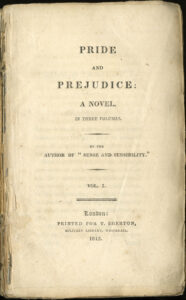
An early version was offered to a publisher but rejected. Austen later revised the manuscript extensively, and the completed novel was published anonymously in 1813.
Like her earlier novel Sense and Sensibility, it did not initially display her name. The title page identified the author only through a reference to her previous work.
Pride and Prejudice was well received and helped establish Austen’s reputation during her lifetime, although her public identity as the author remained limited.
Austen wrote about the social world she knew: country families, clergymen, landowners, military officers, courtship, inheritance, and the delicate distinctions separating comfort, wealth, and genuine social power.
Her novels are often geographically contained, but their emotional and moral observations are precise. She examines how people behave when they want love, money, status, approval, or the freedom to make their own choices.
Other Books by Jane Austen
Jane Austen completed six major novels:
- Sense and Sensibility, published in 1811.
- Pride and Prejudice, published in 1813.
- Mansfield Park, published in 1814.
- Emma, published in 1815.
- Northanger Abbey, published posthumously in 1817.
- Persuasion, published posthumously in 1817.
She also left shorter works and unfinished manuscripts, including Lady Susan, Sanditon, and The Watsons.
Each of the completed novels explores relationships between personal desire and social pressure. However, they differ significantly in tone. Emma focuses on a privileged heroine whose confidence repeatedly leads her into error. Persuasion is quieter and more melancholic, while Northanger Abbey parodies Gothic fiction and youthful imagination.
Jane Austen’s Death and Literary Legacy
Jane Austen experienced serious illness during the final years of her life. She moved to Winchester in 1817 to receive medical care and died there on July 18, 1817, at the age of 41.
She was buried in Winchester Cathedral.
After her death, her brother Henry publicly identified her as the author of the novels. Her reputation grew gradually during the nineteenth century and expanded dramatically in the twentieth and twenty-first centuries.
Austen is now recognized as one of the most important novelists in English literature. Her influence can be seen in romantic fiction, social comedy, realism, psychological characterization, and novels centered on the relationship between private desire and public expectation.
Her work has generated adaptations, sequels, retellings, academic studies, literary societies, and generations of passionate readers.
The continued relevance of Pride and Prejudice demonstrates the durability of her insight. Technologies, courtship practices, and legal systems may change, but pride, embarrassment, attraction, family pressure, and mistaken judgment remain recognizable.

Leave a Reply