
Few dystopian novels are as intellectually disturbing as Brave New World. Aldous Huxley did not imagine a future dominated only by soldiers, prisons, censorship, or constant physical violence. Instead, he created a society where human beings willingly surrender their individuality because they have been conditioned to love comfort, entertainment, consumption, and artificial happiness.
That unusual method of control is what makes finding truly convincing books like Brave New World more difficult than it first appears. Almost any novel about an oppressive government can be called dystopian, but not every dystopia explores the specific dangers that fascinated Huxley: manufactured pleasure, psychological conditioning, biological engineering, pharmaceutical control, social castes, consumerism, and the gradual disappearance of meaningful human relationships.
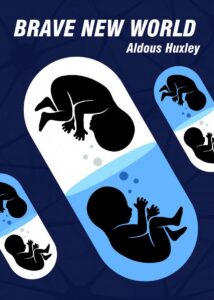
The books selected for this list are not copies of Huxley’s novel. Some imagine governments that rule through fear, while others describe societies controlled by comfort, scientific progress, automation, reproductive policies, or the promise of collective stability. What connects them is their willingness to ask uncomfortable questions about freedom, happiness, technology, and the price human beings may be willing to pay for an apparently perfect society.
If you are still deciding whether Huxley’s classic deserves its legendary reputation, our complete analysis of Brave New World explains its greatest strengths, weaknesses, themes, and relevance for modern readers.
For readers ready to continue exploring classic dystopian fiction, the closest overall recommendation is This Perfect Day by Ira Levin. Readers looking for a historical companion should choose We or 1984, while those seeking a more emotional and modern experience may prefer Never Let Me Go.
None of these recommendations requires prior knowledge of political theory or philosophy. They can be read independently, and this article avoids revealing their most important twists.
Quick Answer: What Should You Read After Brave New World?
If you want an immediate recommendation, these are the strongest choices according to the kind of reading experience you are searching for:
- Closest overall match: This Perfect Day by Ira Levin
- Best foundational dystopia: We by Yevgeny Zamyatin
- Best political companion: 1984 by George Orwell
- Best emotional and literary choice: Never Let Me Go by Kazuo Ishiguro
- Best accessible introduction: The Giver by Lois Lowry
- Best biotechnology dystopia: Oryx and Crake by Margaret Atwood
- Best book about automation: Player Piano by Kurt Vonnegut
- Best exploration of conditioning: A Clockwork Orange by Anthony Burgess
- Best short classic: The Machine Stops by E. M. Forster
- Best quiet and unconventional dystopia: The Unit by Ninni Holmqvist
This Perfect Day is the best place to begin if you want the book that most closely resembles the complete social structure of Huxley’s World State. Its citizens are chemically controlled, assigned predetermined functions, monitored by a technological system, and taught to regard personal choice as a dangerous form of selfishness.
However, each recommendation on this list captures a different part of Huxley’s warning. Reading several of them reveals how many forms a supposedly perfect society can take—and how quickly perfection becomes terrifying when it requires the elimination of human freedom.
What Makes a Book Similar to Brave New World?
The best books similar to Brave New World do not need to reproduce the same plot, characters, or futuristic inventions. What matters is whether they examine comparable conflicts between individual humanity and an organized system determined to eliminate unpredictability.
Huxley’s World State is frightening because it does not appear miserable. Most citizens receive everything they have been taught to want. They have entertainment, material comfort, casual pleasure, social belonging, and soma whenever an unpleasant emotion begins to emerge.
The price of that happiness is almost invisible to them. They have lost family, privacy, art, religion, deep love, independent thought, emotional maturity, and the ability to choose what kind of life they wish to live.
Control Through Pleasure Rather Than Fear
Many famous dystopias depend on obvious oppression. Their governments use prisons, surveillance, executions, propaganda, and physical punishment to terrify the population into submission.
Brave New World proposes a subtler possibility. What if people could be controlled without feeling oppressed? What if they abandoned freedom voluntarily because independence became less attractive than comfort?
Several books on this list explore societies where control is disguised as care, convenience, health, technological efficiency, or social harmony. Their citizens are not always dragged into obedience. Sometimes they accept it, vote for it, benefit from it, or become unable to imagine any alternative.
Conditioning and Manufactured Happiness
Social conditioning is one of the most important features of Huxley’s novel. Citizens are psychologically programmed from childhood to accept their caste, dislike solitude, consume new products, avoid emotional attachment, and repeat the beliefs of the World State without seriously examining them.
Similar processes appear throughout these recommendations. Some characters receive medication that suppresses undesirable emotions. Others are raised in isolated institutions, trained to regard exploitation as normal, or educated to believe that stability is more important than personal choice.
The most disturbing systems are often those that reshape desire itself. A government does not need to prohibit rebellion when citizens have been trained never to want anything different.
Science, Reproduction, and the Human Body
Huxley imagined a civilization in which natural birth has disappeared and human beings are created through industrial processes. Biological differences are deliberately produced so that every citizen will fit a particular social class.
Many of the best dystopian novels inspired by similar anxieties explore:
- artificial reproduction;
- cloning and genetic engineering;
- controlled fertility;
- pharmaceutical manipulation;
- medical experimentation;
- eugenics and biological selection;
- human bodies treated as economic resources.
These stories ask what happens when scientific knowledge develops faster than ethical responsibility. Technology may reduce suffering or improve health, but it can also allow institutions to decide which lives are valuable, which characteristics are desirable, and what purpose each person should serve.
Consumerism, Technology, and Social Castes
Citizens of the World State are constantly encouraged to consume. Repairing old possessions is discouraged because stability depends on continuous production and purchasing. Entertainment occupies attention, while citizens are trained to associate consumption with happiness and social responsibility.
Other books on this list imagine comparable divisions between technological elites and socially disposable populations. Some societies classify people according to intelligence, fertility, professional usefulness, or biological value. Others allow machines and corporations to decide who receives comfort and who becomes unnecessary.
These stories turn economic systems into moral questions. Is a person still valuable when a machine can perform that person’s job? Can a society call itself humane while treating bodies as resources? Does efficiency improve civilization if millions of people lose purpose and dignity?
Freedom Versus Stability
At the heart of Brave New World is a philosophical conflict between freedom and stability. The World State has eliminated many recognizable forms of suffering. There is little war, poverty, disease, romantic jealousy, or social uncertainty. Citizens are protected from emotional pain before they even learn how to understand it.
Yet they are also prevented from experiencing many things that make human life meaningful: sacrifice, commitment, grief, artistic creation, moral growth, spiritual searching, and personal choice.
The central question behind these thought-provoking science fiction books is therefore not simply whether a society is comfortable. It is whether comfort remains desirable when it requires people to become less human.
An Important Note About These Recommendations
The novels and stories below are connected to Brave New World through ideas rather than identical plots. They approach dystopian society from different historical periods, cultures, literary traditions, and political perspectives.
Some use direct authoritarian violence. Others portray control as compassionate, rational, or medically necessary. One focuses on automation, another on cloning, another on reproductive utility, and another on dependence upon technological convenience.
The writing styles also vary considerably. We is experimental and mathematically surreal. 1984 is direct and politically intense. Never Let Me Go is quiet and emotionally restrained. A Clockwork Orange uses an invented form of slang, while The Machine Stops delivers its warning in a much shorter format.
Consequently, readers should not expect every recommendation to reproduce the satire or emotional distance of Aldous Huxley. Instead, each book expands one or more of the following concepts:
- the destruction of individuality;
- the manipulation of desire;
- the use of medicine or conditioning as control;
- the political management of reproduction;
- the division of humanity into useful and disposable groups;
- the replacement of meaning by consumption or entertainment;
- the danger of allowing technology to define human value;
- the conflict between personal freedom and social stability.
How We Chose the Best Books Like Brave New World
Rather than selecting only the most famous dystopian novels, this list prioritizes books that illuminate particular aspects of Huxley’s World State.
- Thematic similarity: Each recommendation shares at least one major concern with Brave New World.
- Literary quality: The books provide compelling ideas, memorable worlds, or emotionally powerful narratives.
- Originality: Each author approaches social control from a distinct perspective.
- Accessibility: The list includes both challenging classics and approachable modern novels.
- Variety: The recommendations represent different decades, nationalities, styles, and forms of dystopian fiction.
- Lasting relevance: Their questions about technology, biology, labor, medicine, and freedom continue to inspire discussion.
The books are ordered primarily according to their thematic closeness to Brave New World, not according to sales, popularity, or overall literary importance.
1. This Perfect Day by Ira Levin — The Closest Overall Match
What Is This Perfect Day About?
Published in 1970, Ira Levin’s This Perfect Day presents a future civilization united under a technological system that promises peace, health, cooperation, and equality.
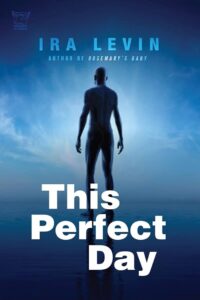
A central computer commonly called Uni organizes nearly every aspect of human life. It determines where people live, what work they perform, whom they marry, and when they may reproduce. Citizens receive regular medical treatments that regulate their emotions and make them calm, satisfied, and cooperative.
Individual decisions are treated with suspicion because personal preference could disrupt social harmony. Even language reflects the ideal of collective unity. Citizens regard themselves as members of one enormous human family, while counselors monitor behavior and correct signs of dissatisfaction.
The protagonist is known officially through an identifying code, although his grandfather gives him the more personal nickname Chip. A small physical irregularity and the influence of his grandfather encourage Chip to imagine something his society considers deeply antisocial: choosing what he wants for himself.
That apparently simple desire gradually exposes the enormous structure of control hidden beneath the civilization’s peaceful surface.
How Is This Perfect Day Similar to Brave New World?
Among all the books like Brave New World on this list, This Perfect Day offers the closest overall combination of chemical control, reproductive administration, technological monitoring, assigned careers, and compulsory happiness.
Like Huxley’s citizens, Levin’s population is not ruled primarily through public brutality. People are made emotionally cooperative through regular treatments and raised to view the social system as benevolent. They have little reason to rebel because their capacity for dissatisfaction has been medically weakened.
Both books portray civilizations that have reduced many traditional human problems. War, hunger, crime, and uncontrolled inequality have largely disappeared. This makes their dystopias more philosophically complicated than societies that are obviously cruel.
The systems can point to genuine accomplishments. Their moral failure lies in what was sacrificed to achieve them.
Both societies also control reproduction and personal relationships. Love, marriage, parenthood, work, and identity become administrative questions rather than private choices. Human beings are treated as components of a global plan whose stability is considered more important than individual desire.
The major difference is narrative style. This Perfect Day places greater emphasis on discovery, conspiracy, and organized resistance. It therefore feels closer to a dystopian thriller than Huxley’s philosophical satire.
Why You Should Read This Perfect Day
Read This Perfect Day if the most disturbing part of Brave New World was not soma itself, but the idea of an entire population chemically prevented from wanting freedom.
Ira Levin takes many concepts associated with Huxley and develops them through a faster, more suspenseful plot. The central mystery surrounding Uni gives the reader a strong reason to continue, while the social system remains detailed enough to inspire serious philosophical discussion.
The novel also understands that a controlled society does not need to look miserable. Citizens receive medical care, security, and material stability. Their world becomes horrifying only when the reader recognizes that every benefit is tied to surveillance and the destruction of meaningful choice.
For readers searching for the single closest recommendation, This Perfect Day should be the first book placed on the list.
2. We by Yevgeny Zamyatin — The Foundational Dystopia of Engineered Conformity
What Is We About?
Written by Russian author Yevgeny Zamyatin in the early 1920s and first published in English in 1924, We is one of the foundational works of modern dystopian literature.
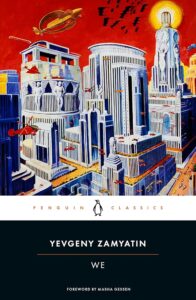
The story takes place in the One State, a mathematically organized civilization surrounded by a barrier known as the Green Wall. Citizens are called Numbers rather than traditional names, live in glass buildings, follow precisely scheduled daily routines, and accept the Benefactor as the center of political authority.
The protagonist, D-503, is an engineer responsible for constructing a spacecraft called the Integral. He begins writing a record intended to explain the perfection of the One State to civilizations beyond Earth.
At the beginning, D-503 sincerely believes that mathematical order has liberated humanity from the chaos of freedom. Individuality appears primitive to him, while personal imagination resembles an illness.
His certainty begins to collapse after he encounters I-330, a mysterious woman who violates rules, awakens unfamiliar desires, and forces him to experience emotions that cannot be reduced to an equation.
How Is We Similar to Brave New World?
We and Brave New World both portray societies obsessed with predictability. Their governments treat spontaneity, imagination, emotional attachment, and private desire as threats to collective stability.
Citizens in both books have been educated to believe that freedom produces suffering. Social peace therefore requires humanity to abandon personal identity and accept a scientifically organized existence.
The novels also share a revealing structural similarity. Their protagonists become increasingly aware of their society after experiencing desire, emotional conflict, and contact with a person who represents forbidden individuality.
In both worlds, the state does not merely regulate public behavior. It attempts to reach the private interior of the human mind. Imagination itself becomes politically dangerous because it allows a person to conceive of alternatives.
However, Zamyatin’s style is more fragmented, symbolic, and mathematically experimental than Huxley’s. D-503’s narration reflects his psychological instability through unusual images, abrupt changes, and numerical metaphors. Readers accustomed to straightforward prose may initially find the novel strange, but that strangeness is one of its greatest strengths.
Why You Should Read We
We is essential for anyone interested in the history of classic dystopian fiction. It helped establish many ideas that would later become central to the genre: numbered citizens, constant surveillance, regulated intimacy, controlled imagination, and rebellion through forbidden emotion.
The book is also worth reading because it is not merely an early version of later dystopias. Zamyatin creates a distinctive world of glass, geometry, machinery, and unstable desire. The prose often feels dreamlike, making the reader experience D-503’s awakening as a psychological fracture rather than a simple political conversion.
Readers should approach claims of direct influence carefully. George Orwell believed Huxley’s novel owed something to We, while Huxley denied having read it before writing Brave New World. Regardless of whether the influence was direct, the thematic connection between the two works is undeniable.
Read We if you want to understand how the modern dystopian tradition began—and if you enjoy novels where the fight for freedom begins inside the mind.
3. 1984 by George Orwell — The Essential Opposite Vision of Control
What Is 1984 About?
Published in 1949, George Orwell’s 1984 follows Winston Smith, a government employee living in the totalitarian superstate of Oceania.
Winston works at the Ministry of Truth, where historical records are continuously rewritten to match the Party’s current claims. The government controls language, information, memory, personal relationships, and even the possibility of private thought.
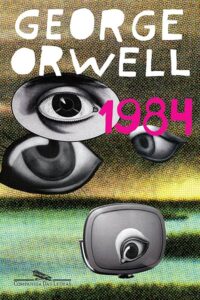
Citizens live beneath the symbolic presence of Big Brother and the threat of constant surveillance. Public loyalty is compulsory, but the Party’s greatest ambition goes beyond outward obedience. It wants people to accept contradictions, distrust their own memories, and become incapable of imagining truth outside official authority.
Winston secretly resents the system and longs for privacy, emotional connection, and an objective reality that exists independently of political power. His quiet rebellion draws him toward dangerous choices.
How Is 1984 Similar to Brave New World?
1984 and Brave New World are frequently discussed together because both describe civilizations that have almost completely destroyed individuality.
In each novel, governments shape language, relationships, education, sexuality, and historical consciousness. Citizens are discouraged from forming loyalties that might compete with the state, while independent thinking becomes socially dangerous.
Both books also recognize that controlling information is not enough. A stable system must control the emotions and desires through which people interpret information.
Orwell and Huxley therefore ask related questions:
- Can truth survive when institutions control language and memory?
- Can love remain meaningful when personal relationships are politically managed?
- Can people defend freedom when they no longer possess the vocabulary to describe it?
- What happens when a government can reshape not only behavior, but consciousness?
How Orwell’s Dystopia Is Fundamentally Different
The primary difference is the method through which obedience is maintained.
In 1984, control depends heavily upon fear. Oceania is poor, gray, violent, and psychologically suffocating. Citizens obey because the consequences of resistance are terrifying. Surveillance, censorship, punishment, propaganda, and public hatred preserve the Party’s authority.
In Brave New World, control depends more heavily upon pleasure. The population receives entertainment, casual relationships, material consumption, and soma. Citizens are conditioned to avoid solitude, discomfort, and serious reflection. They do not need to be constantly forced into submission because they have been taught to enjoy their own dependence.
Orwell imagines people deprived of what they love. Huxley imagines people distracted until they lose the ability to love anything deeply.
This contrast is why the two books complement each other so well. They do not offer competing predictions from which readers must select a winner. They expose different mechanisms through which power can weaken human autonomy.
Why You Should Read 1984
1984 is essential for readers who appreciated the political and philosophical questions raised by Huxley but want a darker, more emotionally immediate story.
Orwell’s prose is generally direct and accessible. The psychological atmosphere, however, is relentless. Winston’s loneliness and fear allow the reader to feel the pressure of Oceania in a way that is often more emotionally intimate than Huxley’s deliberately detached satire.
The novel is especially powerful in its treatment of language. It demonstrates how reducing vocabulary can weaken the ability to formulate resistance and how repeated contradictions can gradually damage confidence in personal perception.
Our detailed review of whether 1984 is still worth reading explores its style, emotional intensity, cultural influence, and accessibility for modern readers.
Readers who finish Orwell’s novel can also discover additional recommendations in our list of books like 1984.
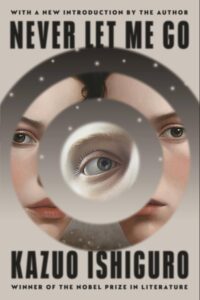
4. Never Let Me Go by Kazuo Ishiguro — The Most Emotional Bioethical Dystopia
What Is Never Let Me Go About?
Published in 2005, Kazuo Ishiguro’s Never Let Me Go initially appears to be a reflective story about childhood, friendship, jealousy, and memory.
The narrator, Kathy H., looks back on her years at Hailsham, an isolated English boarding school where she grew up alongside Tommy, Ruth, and other students. The children receive an unusual education, create artwork, follow strict health rules, and remain separated from the ordinary world.
Teachers reveal information gradually, often speaking indirectly about the students’ future. Kathy and her friends understand pieces of their situation without immediately confronting its full meaning.
This slow realization is central to the novel’s emotional power. Ishiguro does not introduce the dystopian system through speeches, battles, or dramatic explanations. He allows the reader to discover it through incomplete memories and the quiet behavior of characters who have been raised to accept their predetermined roles.
How Is Never Let Me Go Similar to Brave New World?
Both novels imagine societies that use biological science to produce human beings for specific purposes.
In Brave New World, embryos are engineered and conditioned to occupy social castes. In Never Let Me Go, the characters’ origins and futures are connected to a medical system that values their bodies for what they can provide to others.
The deepest similarity is not the technology itself. It is the way exploitation becomes ordinary.
The students at Hailsham are not kept obedient through visible chains. They are educated within an environment that limits what they know and shapes how they interpret their lives. By the time they understand their social purpose, that purpose already feels inevitable.
This resembles the conditioning of Huxley’s citizens. Both systems become powerful because their populations struggle to imagine themselves outside the identities assigned to them.
The novels also ask whether scientific progress can be called humane when it depends upon denying the full humanity of certain people. Other citizens benefit from the system without wanting to examine the suffering hidden beneath those benefits.
The Greatest Difference: Emotional Intimacy
Huxley often creates emotional distance deliberately. His characters represent different attitudes toward the World State, and many readers remember the civilization’s ideas more clearly than the intimate psychology of every individual.
Ishiguro takes the opposite approach. Never Let Me Go is deeply concerned with small memories, misunderstandings, friendships, regrets, and moments of affection. Its dystopian horror grows from the ordinary emotional lives of people whom society has classified as less important.
The novel rarely raises its voice. That restraint makes it devastating. The reader recognizes the injustice long before the characters are able—or willing—to name it completely.
Why You Should Read Never Let Me Go
Read Never Let Me Go if you admired Huxley’s ideas but wanted a more intimate, character-driven, and emotionally moving story.
The prose is elegant and accessible, but the narrative requires patience. Much of the meaning emerges from what Kathy avoids saying, what the adults refuse to explain, and what the students have learned not to question.
It is one of the strongest modern examples of dystopian books about society because it shows oppression operating without constant spectacle. The system survives through social acceptance, euphemism, emotional conditioning, and the willingness of ordinary people to benefit from injustice they would rather not see.
For many readers, this is the most emotionally unforgettable book on the list.
5. The Giver by Lois Lowry — The Most Accessible Story About Engineered Sameness
What Is The Giver About?
Lois Lowry’s The Giver, published in 1993, is set in a carefully organized community that has eliminated war, hunger, uncontrolled emotion, and most forms of uncertainty.
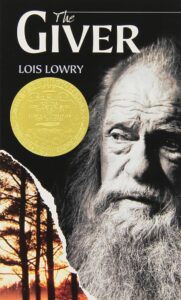
The protagonist, Jonas, is approaching the Ceremony of Twelve, during which children receive the occupations they will perform as adults. Every citizen has an assigned function, family units are created administratively, and daily behavior follows precise rules.
The community has adopted a condition called Sameness. Differences in landscape, climate, perception, and personal choice have been removed to create predictability.
Jonas is selected for the unusual position of Receiver of Memory. Through his training with an older man known as the Giver, he begins experiencing memories of the world before Sameness—memories containing beauty, color, love, pain, violence, loss, and joy.
As his emotional understanding grows, Jonas recognizes that the community’s peaceful surface conceals an enormous moral cost.
How Is The Giver Similar to Brave New World?
The Giver and Brave New World both portray societies that have eliminated suffering by eliminating choice.
Citizens receive assigned social roles, reproduction is controlled, family structures are manufactured, and medication suppresses emotions that might disrupt stability. Language is carefully regulated, while unpleasant aspects of reality are hidden behind calm official terminology.
Both books also remove historical awareness. Huxley’s society discourages serious engagement with the past because history could inspire comparison and dissatisfaction. In Lowry’s community, memories of the past are concentrated within a single person, leaving everyone else unable to understand what humanity has lost.
Jonas resembles John in one important sense: both characters gain access to emotional and cultural experiences that reveal the emptiness of their society’s artificial peace.
Yet The Giver is more accessible in style and structure. Its prose is clear, its central perspective is consistent, and its mysteries unfold gradually. Although commonly categorized as young adult fiction, its questions about memory, choice, reproduction, and moral responsibility are not limited to younger readers.
Why You Should Read The Giver
The Giver is an excellent choice for readers who find older dystopian classics intimidating.
The novel is relatively short and easy to follow, but it still examines profound questions. Can people appreciate pleasure if they have never experienced pain? Is safety valuable when citizens cannot make meaningful choices? Can moral responsibility exist without knowledge of history?
Lowry also demonstrates that the elimination of visible conflict does not necessarily produce justice. A society may appear polite and peaceful while committing terrible acts through routine bureaucracy.
Read this book if you want a concise, approachable, and emotionally effective exploration of loss of individuality and engineered social harmony.
6. Oryx and Crake by Margaret Atwood — The Best Modern Biotechnology Dystopia
What Is Oryx and Crake About?
Published in 2003, Margaret Atwood’s Oryx and Crake follows a man calling himself Snowman as he survives in the remains of a devastated world.

Through flashbacks, readers learn that Snowman was once Jimmy, a boy raised in a society dominated by powerful corporations, private scientific compounds, genetic experimentation, and pharmaceutical engineering.
Jimmy’s childhood friend Crake becomes a brilliant scientist whose ambitions extend far beyond ordinary medical research. Oryx, a mysterious woman connected to both men, becomes equally important to the emotional and ethical structure of the story.
The novel moves between Jimmy’s past and Snowman’s present, gradually explaining how the earlier civilization transformed biological life into a commercial product and how that process contributed to catastrophe.
How Is Oryx and Crake Similar to Brave New World?
Both novels imagine societies where biology becomes an industry.
In Huxley’s World State, human reproduction follows the logic of the assembly line. Embryos are produced, modified, classified, and prepared for predetermined economic functions.
Atwood expands this anxiety into a world of corporate laboratories, engineered animals, pharmaceutical products, privatized communities, and scientists capable of redesigning humanity itself.
The societies in both books are also intensely commercial. Products promise pleasure, youth, health, and emotional relief. Scientific innovation is rarely separated from profit, while advertising teaches consumers what to desire.
Sexuality, appearance, medicine, and entertainment become market categories. Human dissatisfaction creates business opportunities, and corporations gain influence over the most intimate areas of life.
Both authors also question attempts to remove undesirable human characteristics through scientific planning. Crake and the leaders of the World State believe that conflict, jealousy, aggression, and emotional instability can be solved by redesigning human behavior.
The danger lies in assuming that the complexity of humanity is merely a technical defect.
Why You Should Read Oryx and Crake
Read Oryx and Crake if the reproductive technology and genetic engineering of Brave New World were the elements you found most fascinating.
Atwood’s world feels more contemporary than Huxley’s because corporations play a central role. Political power has not disappeared, but commercial laboratories and private compounds increasingly determine the direction of civilization.
The book also combines dystopian fiction with post-apocalyptic survival. Readers gradually move between the consequences of catastrophe and the cultural conditions that made it possible.
Its structure is darker and less orderly than Huxley’s. The world is filled with environmental damage, social inequality, online exploitation, and corporate competition. Yet the central warning remains familiar: technological ability does not guarantee moral wisdom.
Oryx and Crake is one of the strongest choices for readers looking for modern technological dystopia shaped by biotechnology and consumer culture.
7. Player Piano by Kurt Vonnegut — The Best Match for Technological Castes
What Is Player Piano About?
Published in 1952, Player Piano was Kurt Vonnegut’s first novel. It imagines a United States where extensive automation has replaced most human workers.
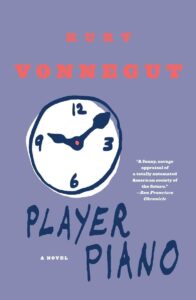
Factories operate with very little direct human labor, while engineers and managers occupy a privileged social class responsible for maintaining the machines. People whose work has become unnecessary are separated economically and culturally from the technological elite.
The protagonist, Paul Proteus, is a successful manager who has benefited enormously from this system. Despite his status, he feels increasingly dissatisfied with a society that measures human worth primarily through technical usefulness.
As Paul encounters people displaced by automation and begins questioning his own position, he is drawn toward resistance. The novel examines not only unemployment, but also the loss of dignity, purpose, and social belonging that follows when machines become more valuable than the people they replaced.
How Is Player Piano Similar to Brave New World?
The strongest connection between the two novels is their division of society according to economic function.
Huxley’s World State biologically produces Alphas, Betas, Gammas, Deltas, and Epsilons. Each caste is conditioned to enjoy the work assigned to it, creating a social hierarchy that appears stable because people have been designed not to resent their position.
Vonnegut’s society creates a comparable hierarchy through education, testing, automation, and professional status. Engineers and managers become a powerful elite, while millions of people discover that the economy no longer considers their abilities necessary.
Both books criticize the idea that efficiency is the highest social value. A system may produce goods successfully and reduce certain forms of disorder while simultaneously depriving human beings of agency and meaning.
Player Piano also portrays oppression as something produced partly through indifference. The machines are not evil, and many leaders believe automation represents progress. The tragedy comes from designing society around technical performance without considering what people need in order to experience dignity.
Why You Should Read Player Piano
This book is particularly interesting for modern readers concerned about automation, algorithms, and the future of work.
Vonnegut wrote long before contemporary debates about artificial intelligence and large-scale digital automation, yet his central question remains strikingly current: what happens to people when society continues to provide for their physical survival but no longer considers their participation meaningful?
The novel is more openly focused on economics and labor than Brave New World. It therefore expands Huxley’s social castes into a critique of technological unemployment and professional elitism.
Read Player Piano if you enjoy satirical science fiction and want a dystopia in which the central threat is not a visibly evil machine, but a civilization that has reorganized itself around mechanical efficiency.
8. A Clockwork Orange by Anthony Burgess — The Best Exploration of Conditioning and Free Will
What Is A Clockwork Orange About?
Anthony Burgess’s A Clockwork Orange, published in 1962, follows Alex, a highly intelligent but violent teenager living in a troubled near-future society.
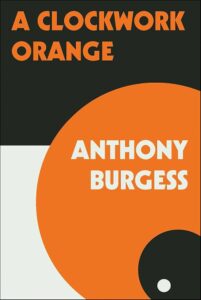
After being arrested, Alex becomes involved in an experimental government program intended to make violent behavior psychologically impossible.
The authorities are less interested in whether Alex becomes morally responsible than in whether he becomes harmless. Through conditioning, his body is trained to reject actions that the state considers unacceptable.
This process produces the novel’s central philosophical conflict. If Alex can no longer choose wrongdoing, has he become good—or has he lost the capacity to be a moral human being at all?
The novel is also famous for Nadsat, a fictional youth slang influenced heavily by Russian vocabulary. The language can feel difficult during the opening pages, but readers gradually learn its meaning through context.
How Is A Clockwork Orange Similar to Brave New World?
Both novels place psychological manipulation at the center of political control.
Citizens in the World State are conditioned from childhood to respond automatically to ideas, objects, and behaviors. Their preferences have been constructed so effectively that obedience feels natural.
Alex’s treatment applies a related principle to an individual. The government attempts to bypass moral reflection and create an automatic physical response.
The comparison exposes a crucial distinction between behavior and morality. A person may perform the actions society desires without possessing freedom, compassion, or ethical understanding.
Huxley’s citizens are socially useful because conditioning prevents them from desiring alternatives. Alex is supposed to become socially safe because conditioning prevents him from acting upon certain desires.
In both cases, human complexity is treated as a mechanical problem that scientific authorities believe they can solve.
Why You Should Read A Clockwork Orange
Read this novel if the conditioning centers of Brave New World made you question the relationship between free will and social order.
Burgess does not offer a comfortable choice. Alex’s behavior creates genuine danger, but the state’s solution is also dehumanizing. The reader is forced to consider whether freedom remains morally necessary even when people use it badly.
The invented language makes the reading experience unusual. It initially distances the reader from the world, but it also demonstrates how language can shape perception and group identity.
This is not the most comfortable recommendation on the list, and its themes include violence and coercive treatment. However, its philosophical argument is exceptionally relevant to Huxley’s concern with human beings transformed into predictable mechanisms.
9. The Machine Stops by E. M. Forster — The Best Short Classic About Comfort and Technology
What Is The Machine Stops About?
First published in 1909, E. M. Forster’s The Machine Stops is a science fiction short story rather than a full-length novel. Despite its age and relatively short length, it presents one of literature’s most memorable visions of technological dependence.
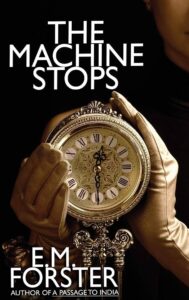
Humanity lives underground in standardized private rooms. A global system known simply as the Machine provides food, communication, medicine, entertainment, information, and nearly every physical necessity.
People rarely meet face to face. They communicate through screens, exchange ideas remotely, and regard direct contact with the natural world as inconvenient or uncivilized.
Vashti is satisfied with this existence. Her son Kuno is not. He wants physical experience, independence, and contact with the surface of the Earth.
As Kuno questions the Machine, the story reveals how completely humanity has lost the knowledge and physical ability required to live without technological support.
How Is The Machine Stops Similar to Brave New World?
The Machine does not need to maintain obedience through constant visible punishment. Most citizens willingly remain inside their rooms because the system offers convenience, comfort, social recognition, and protection from physical difficulty.
This makes the story one of the closest matches to Huxley’s idea of control through pleasure and dependency.
Both societies encourage citizens to avoid discomfort. Physical experience, solitude, strong emotion, and independent exploration become undesirable because the system provides an easier substitute.
The inhabitants of Forster’s world also become disconnected from direct reality. Knowledge is increasingly based on repeated interpretations rather than personal observation. People prefer discussing secondhand ideas to encountering the world itself.
This resembles the World State’s replacement of serious art, history, religion, and reflection with shallow entertainment and conditioned opinion.
Perhaps the most important similarity is that citizens lose freedom without experiencing a dramatic moment in which it is taken from them. Dependence grows gradually until alternatives become unimaginable.
Why You Should Read The Machine Stops
This is the best recommendation for readers who want a powerful dystopian classic they can finish quickly.
Forster wrote the story before computers, video calls, social media, and the modern internet, yet his society communicates through screens, avoids physical interaction, and depends upon a global technological network for daily life.
Its relevance does not depend upon claiming that Forster predicted every modern invention perfectly. The lasting power comes from his understanding of human behavior. Convenience can weaken skills, physical isolation can appear efficient, and a tool created to serve humanity can gradually become an unquestionable authority.
Read The Machine Stops if you were fascinated by the endless entertainment and artificial comfort of Brave New World. It delivers a similar warning in a more concentrated form.
10. The Unit by Ninni Holmqvist — The Best Quiet Dystopia About Human Utility
What Is The Unit About?
Originally published in Swedish in 2006 and later translated into English, Ninni Holmqvist’s The Unit imagines a society that classifies certain middle-aged adults as dispensable.
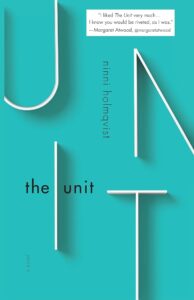
People who have not fulfilled socially approved expectations involving reproduction, family, or essential professional contributions may be transferred to a comfortable institutional facility.
Inside the Unit, residents receive excellent food, recreation, cultural activities, medical care, and luxurious surroundings. However, they also undergo continuous observation, scientific experimentation, and organ donation.
The narrator, Dorrit, enters this environment knowing that society considers her life less valuable than the lives of people with children or officially important occupations.
Her experiences reveal how easily a civilization can disguise exploitation through comfortable architecture, polite language, medical professionalism, and utilitarian arguments about the greatest benefit for the greatest number.
How Is The Unit Similar to Brave New World?
Both novels imagine societies where the state evaluates human beings according to social and biological usefulness.
In Brave New World, citizens are manufactured to perform predetermined roles. Their bodies and minds belong to a system designed around collective stability.
In The Unit, people who fail to satisfy reproductive or economic expectations are treated as resources whose bodies can benefit more socially valuable citizens.
Neither society needs to describe itself as cruel. Decisions are defended through efficiency, health, responsibility, and collective welfare. The institutions appear clean and rational, while the language surrounding them reduces the emotional visibility of suffering.
The Unit’s comfort is especially reminiscent of Huxley. Residents are not placed inside a visibly brutal prison. Their needs are met, their surroundings are pleasant, and they form friendships. Material comfort makes the system easier for outsiders to justify without changing its fundamental injustice.
Both books also challenge the idea that political oppression must originate with a single obvious dictator. Dehumanization can emerge through administrative procedures, popular values, and a society’s shared assumptions about which lives matter most.
Why You Should Read The Unit
The Unit is an excellent choice for readers seeking a less famous and more emotionally intimate dystopia.
The book’s tone is quiet, reflective, and unsettling rather than action-heavy. Its most frightening moments often involve ordinary routines because the injustice has become completely institutionalized.
It also expands the themes of Brave New World into questions about aging, fertility, family expectations, bodily autonomy, and social usefulness.
Who has the authority to decide whether a life has contributed enough? Should parenthood determine social value? Can voluntary language remain meaningful when the alternatives have been politically restricted?
Read The Unit if you want a dystopian novel about society that feels plausible precisely because its system presents itself as compassionate.
Which Book Is Most Similar to Brave New World?
The answer depends upon which part of Huxley’s novel you want to encounter again.
The Closest Overall: This Perfect Day
This Perfect Day is the closest overall recommendation because it combines pharmaceutical control, technological surveillance, assigned careers, reproductive management, and manufactured satisfaction.
It also preserves Huxley’s most unsettling contradiction: the system has solved genuine social problems, yet its achievements depend upon weakening the individuality of nearly every person alive.
The Closest in Social Structure: We
We is the strongest choice for readers interested in mathematical order, collective identity, regulated intimacy, and the treatment of imagination as a political illness.
Its One State resembles the World State in its determination to transform unpredictable human beings into standardized components of a perfectly organized civilization.
The Best Political Contrast: 1984
1984 is not the closest match in atmosphere, but it is the essential intellectual companion.
Orwell demonstrates how power controls people through deprivation, fear, and the destruction of truth. Huxley demonstrates how power might achieve comparable results through abundance, pleasure, and distraction.
The Closest in Biotechnology: Never Let Me Go and Oryx and Crake
Never Let Me Go explores biological exploitation through memory, friendship, and quiet emotional tragedy. Oryx and Crake approaches biotechnology through corporate power, environmental collapse, and large-scale genetic ambition.
Choose Ishiguro for intimacy and Atwood for a broader speculative world.
The Closest in Conditioning: The Giver and A Clockwork Orange
The Giver examines a whole community shaped through medication, controlled memory, and social training. A Clockwork Orange concentrates on an individual whose body is conditioned to make certain choices impossible.
Together, they expose the difference between genuine moral development and mechanically produced behavior.
The Closest in Comfort and Technology: The Machine Stops
The Machine Stops is the best choice for readers interested in dependency, isolation, mediated communication, and a population that loses autonomy because convenience makes independence seem unnecessary.
Which Book Should You Read First?
Your ideal starting point depends on the aspect of Brave New World you enjoyed most.
- Read This Perfect Day for the closest overall reading experience.
- Read We to explore the foundations of modern dystopian fiction.
- Read 1984 for the most important political contrast.
- Read Never Let Me Go for emotional and character-driven literary fiction.
- Read The Giver for a shorter and more accessible novel.
- Read Oryx and Crake for biotechnology, corporate science, and genetic experimentation.
- Read Player Piano for automation, employment, and technological inequality.
- Read A Clockwork Orange for a philosophical exploration of conditioning and free will.
- Read The Machine Stops for a quick classic about technological dependence.
- Read The Unit for an intimate and unconventional dystopia about human utility.
Readers completely new to dystopian classics will probably find The Giver or 1984 easiest to approach. Those already comfortable with experimental literature should consider We, while readers primarily interested in modern literary fiction should begin with Never Let Me Go.
More Dystopian Books to Read After Brave New World
The following books were not placed in the main ranking because some already appear prominently in other Reader Habitat recommendations or because they focus on themes slightly further from Huxley’s specific combination of conditioning, consumption, and biological planning.
They are nevertheless excellent choices for anyone exploring the best dystopian novels.
- Fahrenheit 451 by Ray Bradbury: A powerful defense of literature, critical thinking, and meaningful human connection in a society dominated by censorship and shallow entertainment.
- The Handmaid’s Tale by Margaret Atwood: A disturbing examination of reproductive control, religious authoritarianism, gender, and political power.
- Kallocain by Karin Boye: A psychological dystopia centered on surveillance, loyalty, confession, and a truth-inducing drug.
- The Wanting Seed by Anthony Burgess: A dark satire about overpopulation, social policy, political cycles, and reproductive control.
- The Memory Police by Yoko Ogawa: A quiet and surreal novel about disappearing objects, suppressed memories, and the fragility of personal identity.
- The Dispossessed by Ursula K. Le Guin: A philosophically rich examination of freedom, social organization, property, and the limitations of competing political systems.
Several of these titles appear naturally alongside Orwell’s work. Our separate guide to books similar to 1984 is the better place to explore dystopias focused primarily on surveillance, censorship, and direct authoritarian oppression.
What Should You Read Next by Aldous Huxley?
Readers do not need to leave Aldous Huxley behind after finishing Brave New World. His other books reveal different sides of his thinking about society, consciousness, technology, politics, and human potential.
Island
Published in 1962, Island is often viewed as a thematic counterpart to Brave New World.
The novel describes the fictional island of Pala, whose society combines scientific education, psychological awareness, spiritual practices, preventive medicine, and community responsibility.
Unlike the World State, Pala attempts to use knowledge without eliminating freedom and emotional depth. The book does not present a perfect society without problems, but it allows Huxley to examine more constructive possibilities after decades of writing about manipulation and mass culture.
Island is not a sequel. It contains different characters, a different setting, and an independent narrative. Its connection to Brave New World is philosophical rather than chronological.
Brave New World Revisited
Published in 1958, Brave New World Revisited is a nonfiction work in which Huxley returned to many of the concerns behind his famous novel.
He discusses propaganda, overpopulation, mass communication, political manipulation, education, and the psychological methods through which free societies might gradually become less free.
This is the best next choice for readers more interested in Huxley’s arguments than in another fictional story. It shows how the author reconsidered his earlier warnings after observing the political and technological developments of the following decades.
Point Counter Point
First published in 1928, Point Counter Point is one of Huxley’s major pre-Brave New World novels.
It focuses on intellectual life, relationships, politics, art, and social conflict through a large cast of characters. The structure reflects the musical concept suggested by its title, placing contrasting personalities and ideas against one another.
Readers primarily interested in Huxley as a literary novelist and social satirist may find it especially rewarding.
Who Was Aldous Huxley?
A Brief Biography
Aldous Leonard Huxley was born on July 26, 1894, in Godalming, Surrey, England. He belonged to a prominent family associated with science, literature, and education.
His grandfather, Thomas Henry Huxley, was a famous biologist and defender of Charles Darwin’s theory of evolution. His brother Julian Huxley became a biologist and writer, while his half-brother Andrew Huxley later received the Nobel Prize in Physiology or Medicine.
During his youth, Aldous Huxley developed an eye condition that left him almost blind for a period and prevented him from pursuing his early ambition of becoming a doctor. His vision eventually improved enough for him to study English literature at Balliol College, Oxford.
Huxley began his career writing poetry, short stories, essays, and satirical novels. His early fiction often examined the intellectual and moral confusion of modern society.
An experience working at a technologically advanced chemical plant during the 1920s contributed to his interest in organized industrial systems. That fascination later became important to the mass production, scientific planning, and biological factories imagined in Brave New World.
He published the novel in 1932. Although it became his most famous work, his career extended across fiction, philosophy, social criticism, travel writing, screenwriting, and studies of consciousness and religion.
Huxley moved to the United States during the late 1930s and spent much of the remainder of his life in California. His later writing increasingly addressed pacifism, mysticism, human potential, and the ethical use of psychological knowledge.
He died on November 22, 1963, in Los Angeles County, California, at the age of 69.
Huxley’s Other Important Books
- Island — A philosophical novel presenting a more hopeful social alternative.
- The Doors of Perception — A nonfiction work about perception and Huxley’s experience with mescaline.
- Point Counter Point — A large intellectual and social novel published before Brave New World.
- Eyeless in Gaza — A philosophical novel exploring morality, transformation, and pacifism.
- Brave New World Revisited — Huxley’s nonfiction reassessment of the dangers presented in his dystopian novel.
- The Perennial Philosophy — A study of ideas shared across different mystical and religious traditions.
Huxley’s literary legacy extends far beyond one dystopian novel. His work repeatedly asks how science, culture, education, and institutions shape human consciousness—and whether knowledge will be used to expand freedom or quietly eliminate it.
Frequently Asked Questions About Books Like Brave New World
What book is most similar to Brave New World?
This Perfect Day by Ira Levin is the closest overall match. Its society uses regular medical treatments, technological monitoring, reproductive control, assigned occupations, and emotional conditioning to maintain collective stability.
We is another extremely close thematic companion, particularly in its treatment of social uniformity, regulated relationships, and the suppression of imagination.
Is 1984 similar to Brave New World?
Yes. Both books portray governments that destroy individuality, regulate personal relationships, manipulate thought, and place political stability above human freedom.
Their main difference is the method of control. 1984 depends more heavily upon fear, deprivation, surveillance, and punishment. Brave New World depends upon conditioning, pleasure, consumption, entertainment, and artificial happiness.
Is Island a sequel to Brave New World?
No. Island is an independent novel with different characters and a separate setting.
It is frequently considered a philosophical counterpart because it explores how science, psychology, education, and spiritual practices might be used to support a healthier society rather than a controlled dystopia.
Which book should I read if I liked the idea of soma?
This Perfect Day is the strongest recommendation because citizens receive regular treatments that regulate emotion and maintain cooperation.
The Giver also includes medication used to suppress strong feelings, while A Clockwork Orange examines a more aggressive form of psychological and physical conditioning.
Which recommendation is easiest to read?
The Giver is probably the most accessible full-length novel on the list. It uses clear prose, a focused perspective, and a gradually unfolding mystery.
The Machine Stops is the quickest recommendation because it is a short story, although its older writing style may require slightly more attention.
Which book is the most emotional?
Never Let Me Go is the most emotionally intimate recommendation. Its dystopian system is revealed through childhood memories, friendship, love, jealousy, and regret rather than through a conventional rebellion plot.
The Unit is another strong choice for readers interested in quiet emotional tension.
Which book focuses most on genetic engineering?
Oryx and Crake places genetic experimentation and pharmaceutical engineering at the center of its world.
Never Let Me Go is more closely focused on cloning and medical ethics, while Brave New World itself emphasizes artificial reproduction and biological caste production.
Are all these books dystopian novels?
Most are dystopian novels, although The Machine Stops is a short story. Some books also cross into speculative fiction, science fiction, satire, post-apocalyptic fiction, or young adult literature.
What connects them is not a single genre label, but their examination of societies that sacrifice human autonomy in the name of order, progress, safety, or collective happiness.
Do these books need to be read in any order?
No. Every book in the main list is independent.
Readers interested in literary history could begin with The Machine Stops, continue to We, and then read Brave New World, 1984, and the later novels in publication order. However, this is entirely optional.
What is the best modern book like Brave New World?
Never Let Me Go is the strongest modern recommendation for readers seeking emotional literary fiction, while Oryx and Crake is the best choice for biotechnology, corporate control, and environmental anxiety.
The Unit is especially valuable for readers who want a quieter and less predictable contemporary dystopia.
Final Thoughts on the Best Books Like Brave New World
No single novel can reproduce everything that makes Aldous Huxley’s dystopia so memorable.
Brave New World combines satire, science fiction, philosophy, consumer culture, reproductive technology, psychological conditioning, and social criticism in a way that remains distinctive. Its greatest warning is not simply that governments may take freedom away. It is that people may gradually lose interest in freedom when pleasure and stability become easier than uncertainty and responsibility.
The strongest books like Brave New World expand that warning in different directions.
This Perfect Day provides the closest overall society, using medication and technology to create compulsory satisfaction. We reveals the mathematical and psychological foundations of modern dystopian fiction. 1984 presents the essential opposite vision of control through fear and deprivation.
Never Let Me Go transforms biological exploitation into a deeply emotional story, while The Giver makes the sacrifice of memory and choice accessible to a wide audience. Oryx and Crake updates Huxley’s anxieties through corporations, pharmaceuticals, and genetic engineering.
Player Piano asks what happens when technology makes human labor unnecessary. A Clockwork Orange questions whether morality can exist without free will. The Machine Stops shows comfort becoming dependency, and The Unit exposes the danger of measuring human worth through reproductive and economic usefulness.
If you choose only one book, begin with This Perfect Day. It is the recommendation that most closely combines the major elements of Huxley’s society while offering a more suspenseful narrative.
Choose Never Let Me Go if you want something emotional, 1984 if you want political intensity, and Oryx and Crake if modern biotechnology is your greatest interest.
Readers who want an even darker story about humanity losing control of its own technology can continue with our analysis of I Have No Mouth, and I Must Scream, a short work of philosophical science fiction that takes technological domination in a far more horrifying direction.
Ultimately, the most disturbing dystopian societies are not always those that openly forbid freedom. Sometimes they are the ones that provide so much comfort, distraction, and artificial satisfaction that their citizens forget why freedom was valuable in the first place.
References
- Brave New World — Wikipedia
- This Perfect Day — Wikipedia
- We — Wikipedia
- Nineteen Eighty-Four — Wikipedia
- Never Let Me Go — Wikipedia
- The Giver — Wikipedia
- Oryx and Crake — Wikipedia
- Player Piano — Wikipedia
- A Clockwork Orange — Wikipedia
- The Machine Stops — Wikipedia
- Ninni Holmqvist and The Unit — Wikipedia
- Aldous Huxley — Wikipedia
- Island — Wikipedia
- Brave New World Revisited — Wikipedia
- Point Counter Point — Wikipedia

Leave a Reply