
Few novels have managed to remain as culturally influential and unsettling as 1984 by George Orwell. Even decades after its original publication in 1949, readers still constantly debate whether this dystopian classic deserves its legendary reputation. Some call it one of the greatest books ever written, while others describe it as emotionally exhausting, terrifying, and painfully realistic.
So, is 1984 actually good?
The short answer is yes — but probably not for the reasons many people expect.
This is not simply a science fiction novel about a dark future. It is a deeply psychological story about fear, control, loneliness, propaganda, and the destruction of truth itself. Orwell creates a world so oppressive and believable that many readers finish the book feeling genuinely disturbed. That emotional impact is one of the biggest reasons why the novel continues to be discussed in schools, online communities, political debates, and literary circles all over the world.
What makes 1984 especially impressive is how accessible it still feels today. Unlike many older classics that can feel slow or overly complicated, Orwell’s writing is direct, sharp, and surprisingly easy to follow. The simplicity of the prose only makes the story more effective, because the horror comes from the ideas themselves rather than from complex language.

Over the years, the book has become famous for concepts like Big Brother, Thought Police, and constant government surveillance. Even people who have never read the novel usually recognize these terms because they became part of modern culture. In fact, many readers are shocked by how relevant the story still feels in an age dominated by digital monitoring, misinformation, social manipulation, and political polarization.
But despite all its praise, 1984 is not necessarily an easy or comfortable read. The atmosphere is intentionally bleak, the themes are emotionally heavy, and Orwell offers very little hope throughout the story. For some readers, that makes the novel unforgettable. For others, it can feel overwhelming or depressing.
In this article, we will explore exactly what makes 1984 such an important and divisive novel. We will look at its story, themes, writing style, emotional impact, cultural influence, and whether it still deserves to be considered one of the greatest dystopian books ever written.
Why 1984 Still Fascinates Readers Decades Later
One of the most remarkable things about 1984 is that it never truly disappeared from public conversation. Many classic novels slowly become historical artifacts that people respect more than they actually read. Orwell’s novel did the opposite. Every new generation seems to rediscover it and find new reasons to discuss it.
Part of this comes from the book’s disturbing ability to feel relevant no matter the era. Readers in different decades constantly compare the world of 1984 to real-world events involving censorship, propaganda, mass surveillance, political extremism, and media manipulation. Even though Orwell wrote the novel in the late 1940s, many of its ideas feel strangely modern.
The novel also fascinates readers because it creates fear without relying on monsters, violence, or supernatural horror. The terror in 1984 comes from psychological control. The idea that a government could manipulate language, rewrite history, erase truth, and invade even private thoughts feels deeply unsettling in a way that stays with readers long after finishing the book.
Another reason the novel remains so powerful is its emotional atmosphere. Orwell creates a world where hope itself becomes dangerous. The constant feeling of paranoia and helplessness makes the reader experience the same emotional pressure as the protagonist, Winston Smith. That immersive psychological tension is one of the main reasons why so many people describe the book as unforgettable.
At the same time, 1984 appeals to many different kinds of readers:
- Fans of dystopian fiction appreciate its dark world-building.
- Philosophy readers enjoy its exploration of truth and power.
- Political readers analyze its warnings about authoritarianism.
- Psychological fiction fans are drawn to its emotional intensity.
- Classic literature readers admire Orwell’s clear and effective prose.
Very few novels manage to combine all of these elements at once. That is a major reason why 1984 continues to attract new readers more than seventy years after its release.
What Is 1984 About?
1984 takes place in a dystopian future where the world is divided into massive superstates constantly at war with one another. The story follows Winston Smith, an ordinary man living in Oceania, a totalitarian society ruled by the terrifying figure known as Big Brother.
In this world, the government controls nearly every aspect of human life. Citizens are constantly watched through telescreens, public behavior is heavily monitored, independent thinking is treated as a crime, and even personal emotions are considered suspicious. The ruling Party does not simply want obedience — it wants complete control over reality itself.
Winston works at the Ministry of Truth, where his job is to rewrite historical records so that the Party always appears correct. Newspapers, speeches, statistics, and past events are constantly altered to match the government’s current narrative. If the Party changes its position on something, history itself is rewritten as if the previous version never existed.
This idea becomes one of the novel’s most disturbing concepts: if a government controls all information, can objective truth survive?
Although Winston initially appears quiet and submissive, he secretly hates the system surrounding him. Deep inside, he desperately wants freedom, individuality, and genuine human connection. That quiet rebellion slowly pushes him toward dangerous decisions that place him directly in conflict with the Party.
Without revealing major spoilers, the novel explores:
- Government surveillance
- Psychological manipulation
- Control of language and information
- The destruction of personal identity
- The fear of independent thought
- The fragility of truth itself
What makes 1984 especially effective is that Orwell does not rely on action or large-scale battles to create tension. Most of the fear comes from conversations, silence, suspicion, and the constant feeling that someone may always be watching.
The world of the novel feels cold, gray, exhausted, and emotionally empty. Food is poor, buildings are decaying, entertainment is artificial, and genuine happiness barely exists. Orwell intentionally removes comfort from almost every aspect of life in Oceania, creating a society where fear becomes normal.
At its core, however, 1984 is not really about futuristic technology or politics alone. It is about what happens when power becomes so absolute that it can shape not only society, but human thought itself.
That psychological focus is one of the biggest reasons why the novel remains so impactful even today.
Why 1984 Is Considered One of the Greatest Dystopian Novels Ever Written
There are many dystopian novels that imagine dark futures, oppressive governments, or collapsing societies. However, very few books have achieved the same level of cultural impact as 1984. George Orwell’s novel did not simply become popular — it fundamentally shaped the way people talk about authoritarianism, surveillance, censorship, and political manipulation.
Even readers who have never opened the book often recognize terms like Big Brother, doublethink, Thought Police, and Room 101. That alone says a lot about how deeply the novel entered modern culture.
But the reason 1984 is considered a masterpiece goes far beyond famous quotes and political references. The novel succeeds because Orwell combines psychological horror, philosophical ideas, emotional tension, and social criticism into one incredibly immersive story.
Unlike many dystopian stories that focus heavily on action or rebellion, 1984 feels painfully personal. The fear does not come from explosions or battles. It comes from watching a human being slowly crushed by a system designed to eliminate individuality itself.
The novel also avoids the trap of becoming overly complicated. Orwell’s writing style is clear and direct, making the themes easy to understand without losing emotional power. In many ways, that simplicity makes the book even more disturbing because the ideas feel realistic and believable.
Another major reason the novel became so respected is its ability to remain relevant across different generations. Readers constantly return to 1984 whenever societies begin debating topics like:
- Government surveillance
- Privacy rights
- Political propaganda
- Media manipulation
- Censorship
- Control of information
- Freedom of speech
Very few books written in the 1940s still feel this modern.
At the same time, 1984 is not universally loved because it is “fun.” In fact, many readers describe it as emotionally draining. The atmosphere is intentionally oppressive, and Orwell rarely gives the audience moments of relief. That emotional heaviness is precisely what makes the story so memorable.
The novel forces readers to confront uncomfortable questions:
- What happens when truth becomes controlled?
- Can freedom exist without privacy?
- How much power should governments possess?
- Can language itself shape reality?
- What remains of a person after individuality is destroyed?
These questions continue to resonate because they are not limited to one political system or one historical moment. They reflect fears that can appear in many forms throughout human history.
That timeless quality is one of the biggest reasons why 1984 continues to be considered one of the greatest dystopian novels ever written.
The Atmosphere of Fear and Surveillance
One of the strongest aspects of 1984 is the suffocating atmosphere Orwell creates throughout the novel. From the very beginning, the reader feels trapped inside a world where privacy no longer exists.
Citizens are watched constantly through telescreens placed inside homes, workplaces, and public spaces. The Party encourages people to spy on neighbors, friends, and even family members. Children are raised to report suspicious behavior, and independent thought itself becomes dangerous.
This constant surveillance creates an overwhelming sense of paranoia. Winston can never fully relax because he knows that even facial expressions or subtle emotional reactions could attract attention from the authorities.
Orwell turns ordinary human behavior into something frightening:
- Writing personal thoughts becomes risky.
- Falling in love becomes rebellious.
- Having privacy becomes suspicious.
- Remembering the past becomes dangerous.
The terrifying part is not only the surveillance itself, but the psychological effect it has on society. People begin controlling their own thoughts out of fear. Over time, the Party barely needs physical force because citizens become mentally conditioned to obey automatically.
This atmosphere of permanent tension makes the novel incredibly immersive. Readers often describe feeling emotionally exhausted after reading long sections because Orwell never truly allows the pressure to disappear.
That emotional discomfort is exactly what gives 1984 so much power.
The Psychological Horror of Losing Individuality
While many dystopian novels focus on violent governments or collapsing societies, the true horror of 1984 is much more psychological. Orwell is not simply showing a dictatorship — he is exploring what happens when a system gains the power to destroy individuality itself.
This is what makes the novel so disturbing.
In Oceania, the Party does not only want citizens to obey laws. It wants complete control over how people think, feel, remember, and even perceive reality. Independent identity becomes a threat because individuality creates the possibility of resistance.
Throughout the novel, Winston struggles to preserve small pieces of humanity that most people normally take for granted:
- Private thoughts
- Personal memories
- Romantic love
- Curiosity
- Individual opinions
- Emotional honesty
Even these simple human experiences become acts of rebellion in Orwell’s world.
One of the most frightening ideas in 1984 is that the Party attempts to erase the concept of objective truth entirely. If the government says something happened, then it becomes reality — even if people remember otherwise. Citizens are expected to accept contradictions without questioning them.
This concept, known in the novel as doublethink, becomes one of Orwell’s most brilliant and unsettling creations. The ability to simultaneously accept two contradictory ideas represents the complete collapse of logical independence.
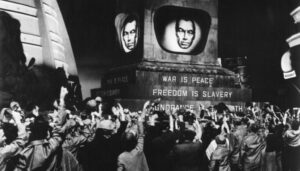
The Party’s slogans perfectly demonstrate this psychological manipulation:
- War is Peace
- Freedom is Slavery
- Ignorance is Strength
These phrases sound absurd at first, but Orwell shows how constant propaganda and fear can slowly force people to accept impossible contradictions as normal.
What makes this psychological horror so effective is how believable it feels. Orwell understood that authoritarian control does not always rely purely on violence. Sometimes it works by exhausting people mentally until they no longer trust their own perceptions.
The novel constantly asks a terrifying question:
If someone controls all information, language, and history, can people still trust their own minds?
This fear gives 1984 an emotional intensity that many readers never forget. The book does not scare readers with monsters or supernatural threats. Instead, it creates fear through the possibility of losing one’s identity, freedom, and connection to reality itself.
That psychological depth is one of the main reasons why the novel remains so respected decades after its publication.
Why Orwell’s Writing Style Works So Well
One reason 1984 continues to attract new readers is that George Orwell’s writing style feels surprisingly modern and accessible. Many people expect classic novels to be difficult, slow, or overly descriptive, but Orwell writes with remarkable clarity and precision.
His prose is simple without feeling shallow.
Instead of relying on complicated literary language, Orwell focuses on atmosphere, ideas, and emotional tension. The sentences are usually direct and easy to understand, which allows the reader to become immersed in the disturbing world of the novel without struggling through dense writing.
This simplicity is actually one of the book’s greatest strengths.
The cold and restrained writing style mirrors the emotional emptiness of Oceania itself. Orwell rarely uses overly dramatic scenes because the horror comes naturally from the situation and the ideas being explored.
Even ordinary descriptions feel uncomfortable:
- Dirty buildings
- Artificial food
- Constant propaganda posters
- Gray city streets
- Mechanical daily routines
- The feeling of being watched everywhere
These details slowly build an oppressive atmosphere that surrounds the reader during the entire novel.
Another reason Orwell’s writing works so well is that he understands pacing. 1984 is not an action-heavy story, yet it rarely feels stagnant because psychological tension constantly pushes the narrative forward.
The reader keeps turning pages not because of explosions or dramatic battles, but because of anxiety. There is a constant sense that something terrible could happen at any moment.
Orwell also explains complex political and philosophical ideas in a way that feels natural inside the story. Concepts like propaganda, manipulation of language, and historical revisionism are woven directly into Winston’s daily life rather than presented like academic lectures.
As a result, readers absorb the themes emotionally instead of simply analyzing them intellectually.
This combination of accessibility, psychological tension, and philosophical depth is a huge reason why 1984 remains one of the easiest classic dystopian novels to recommend even to modern readers who normally avoid older literature.
How the Book Forces Readers to Think
One of the biggest reasons why 1984 continues to be discussed so heavily is that the novel does not simply entertain readers — it challenges them intellectually and emotionally.
Many books are enjoyable while reading them but quickly fade from memory afterward. Orwell’s novel tends to do the opposite. Readers often finish the book and continue thinking about its ideas for weeks, months, or even years.
This happens because 1984 constantly forces readers to question concepts that people normally take for granted:
- What is truth?
- Can history be manipulated?
- How much freedom are people willing to sacrifice for security?
- Can language influence thought itself?
- What happens when people become afraid to speak honestly?
These questions are deeply uncomfortable because they feel relevant far beyond the fictional world of the novel.
Orwell also avoids presenting easy solutions. The book does not offer comforting optimism or simple moral lessons. Instead, it confronts readers with difficult ideas about power, fear, obedience, and psychological control.
That complexity is one reason why the novel appeals to such different audiences. Some readers focus mainly on the political themes, while others become fascinated by the psychological aspects of manipulation and identity. Philosophy readers often interpret the novel as an exploration of truth and reality, while literary readers admire its emotional intensity and atmosphere.
Another important reason the book provokes so much thought is that Orwell understood how fragile truth can become when information is controlled. In Oceania, facts no longer matter independently. Reality changes according to whatever benefits the Party at any given moment.
This idea becomes especially disturbing because Orwell shows how ordinary people slowly adapt to these contradictions. Over time, many citizens stop trusting their own memories and begin depending entirely on official narratives.
That concept feels frighteningly believable.
Readers often find themselves reflecting on how media, politics, social pressure, and technology influence modern society. Even when people disagree about the novel’s political interpretations, they still tend to recognize the importance of its warnings about manipulation and authoritarian control.
Perhaps the greatest strength of 1984 is that it never feels like a simple lecture. Orwell presents these ideas through emotional storytelling rather than abstract theory. The reader experiences the fear, confusion, paranoia, and helplessness alongside Winston.
That emotional connection makes the themes far more powerful than they would be in a purely philosophical or political text.
Very few novels manage to combine psychological tension, political commentary, philosophical depth, and emotional storytelling as effectively as 1984. That is one of the main reasons why the book continues to generate discussion decades after its release.
Is 1984 Difficult or Boring to Read?
One concern many readers have before starting 1984 is whether the novel feels too old, too political, or too difficult to enjoy. Since the book was published in 1949 and is often taught in schools, some people expect it to feel dry or overly academic.
Surprisingly, most readers discover the opposite.
Compared to many classic novels, 1984 is actually very accessible. Orwell’s writing style is clean, direct, and easy to follow. The sentences are rarely complicated, and the story moves steadily without long sections of confusing prose.
In fact, one of Orwell’s greatest strengths is how clearly he communicates difficult ideas. Readers do not need deep political knowledge or literary expertise to understand the novel’s themes.
That said, the book can still feel emotionally heavy.
The atmosphere is intentionally bleak from beginning to end. Oceania is a depressing place filled with fear, surveillance, suspicion, and hopelessness. There are very few moments of comfort or emotional relief, which can make the reading experience exhausting for some people.
Readers looking for fast-paced action may also be surprised by the novel’s slower psychological focus. Much of the tension comes from internal conflict, conversations, propaganda, and emotional pressure rather than physical events.
However, many readers find this psychological approach far more gripping than traditional action.
The novel creates suspense through anxiety and paranoia. Even small acts — writing in a diary, speaking privately, expressing emotion — feel dangerous. That constant tension keeps many readers deeply engaged despite the slower pace.
There is also one section in the middle of the novel that some readers consider slower because it focuses heavily on political ideas and explanations about the Party’s philosophy. Opinions on this part vary greatly:
- Some readers find it fascinating and intellectually powerful.
- Others feel it temporarily slows the narrative momentum.
Still, most people agree that the overall experience remains incredibly memorable.
In the end, whether 1984 feels boring depends heavily on what the reader wants from fiction. Readers who enjoy psychological tension, philosophical themes, dystopian worlds, and emotionally intense stories will likely find the novel extremely compelling.
But readers looking for light entertainment, hopeful narratives, or fast-moving adventure may find the atmosphere too oppressive.
Either way, it is difficult to deny the novel’s impact. Even people who dislike parts of 1984 often admit that the book stays in their minds long after finishing it.
Looking for More Dark Dystopian Books Like 1984?
If George Orwell’s terrifying vision of surveillance, propaganda, and authoritarian control left you wanting more, there are plenty of other unforgettable dystopian novels waiting for you. From psychological oppression to societies built on manipulation and fear, these books explore many of the same disturbing themes that made 1984 such a powerful experience.
Check out our list of the best books like 1984 and discover more dark, thought-provoking classics that will stay in your mind long after the final page.
What Makes 1984 So Relevant Today?
One of the most fascinating things about 1984 is how modern it still feels. Although George Orwell wrote the novel shortly after World War II, many readers today are shocked by how accurately some of its fears seem to connect with contemporary society.
This does not mean the modern world literally resembles Oceania. However, the novel explores ideas and anxieties that continue to appear in political debates, technological discussions, and public conversations around the world.
That is a major reason why 1984 keeps returning to bestseller lists whenever people begin discussing censorship, propaganda, surveillance, or authoritarianism.
Many dystopian novels lose relevance as technology and society change. Orwell’s novel survived because its central concerns are deeply human:
- The fear of losing freedom
- The manipulation of truth
- The abuse of political power
- The influence of propaganda
- The erosion of privacy
- The pressure to conform socially
These fears continue to exist in different forms across every generation.
Modern readers often notice how the book connects to discussions involving:
- Social media influence
- Digital surveillance
- Government data collection
- Fake news and misinformation
- Political polarization
- Online censorship debates
- Manipulation through mass communication
Even the idea of constantly monitored behavior feels more familiar today than it did when Orwell first wrote the novel.
At the same time, the novel remains powerful because Orwell focuses less on predicting exact technology and more on examining how systems of power operate psychologically. The story is ultimately about control over information, memory, fear, and identity.
That psychological dimension gives 1984 a timeless quality that many science fiction novels never achieve.
The book also remains relevant because it encourages skepticism toward simplistic narratives and blind obedience. Orwell constantly reminds readers how easily truth can become distorted when people stop questioning authority or stop thinking independently.
For many readers, this makes 1984 feel less like an old dystopian novel and more like an ongoing warning about human nature and political power.
Mass Surveillance and Privacy
Perhaps the most famous aspect of 1984 is its depiction of constant surveillance. The image of Big Brother watching every citizen became one of the most recognizable symbols in modern literature.
In Oceania, privacy barely exists. Telescreens monitor citizens continuously, public behavior is carefully observed, and even facial expressions can attract suspicion. The Party wants people to feel watched at all times because fear itself becomes a powerful method of control.
When Orwell originally wrote the novel, this level of surveillance seemed terrifyingly futuristic. Today, however, many readers find the concept disturbingly familiar.
Modern society is filled with cameras, digital tracking, smartphones, algorithms, and online data collection. Governments and corporations can gather enormous amounts of information about people’s habits, preferences, locations, and communication.
Of course, real-world technology is far more complex than the simplistic authoritarian system portrayed in 1984. Still, the novel continues to resonate because it captures a fundamental fear:
What happens when people feel they are constantly being observed?
Orwell understood that surveillance affects behavior psychologically. People become more cautious, less spontaneous, and more afraid to express controversial opinions openly. Over time, self-censorship can become automatic.
This idea remains incredibly relevant in modern discussions about:
- Internet privacy
- Government monitoring
- Social media tracking
- Artificial intelligence
- Data collection
- Digital security
Many readers are especially unsettled by how normal surveillance has become in everyday life. In the world of 1984, citizens eventually stop expecting privacy altogether. Orwell presents this not only as a political problem, but as a psychological transformation that changes human behavior itself.
That fear of losing private space — mentally, emotionally, and physically — is one reason why the novel still feels so powerful today.
Manipulation of Truth and Information
Another reason 1984 remains so relevant is its exploration of how governments and institutions can manipulate information to control public perception.
In Oceania, truth is not treated as something objective or permanent. The Party constantly rewrites newspapers, speeches, statistics, and historical records so that reality always supports its current narrative.
If the Party changes its position on an issue, all evidence of the previous version disappears.
Winston’s job at the Ministry of Truth perfectly illustrates this system. He spends his days altering old documents so the government never appears mistaken or inconsistent. Over time, history itself becomes unstable because the past can be rewritten whenever necessary.
This idea terrifies readers because Orwell understood something extremely important:
Controlling information can become a form of controlling reality.
The novel also explores how propaganda works psychologically. The Party floods society with slogans, emotional messaging, fear, and repetitive narratives until citizens stop questioning contradictions.
This manipulation becomes even more dangerous because many people eventually surrender their ability to think independently. Instead of trusting personal memory or evidence, they rely entirely on official narratives.
Modern readers often connect these ideas to contemporary concerns involving:
- Misinformation
- Political propaganda
- Media bias
- Online echo chambers
- Fake news
- Manipulated narratives
- Algorithm-driven information bubbles
Regardless of political perspective, many readers recognize how difficult it can become to separate truth from manipulation in the modern information age.
That is one reason why 1984 continues to generate intense discussion decades after publication. Orwell’s warnings about propaganda and information control feel less like historical speculation and more like timeless concerns about human society.

The Fear of Authoritarian Control
At its core, 1984 is a novel about power — specifically, what happens when political power becomes so absolute that it can dominate every aspect of human life.
The Party in Oceania does not simply govern society. It seeks total control over behavior, thought, memory, emotion, and even reality itself. Orwell presents authoritarianism not just as a political system, but as a force capable of reshaping human psychology.
This is one reason the novel feels so terrifying.
Many dystopian stories focus on governments that become violent or corrupt, but Orwell goes further. In 1984, the Party does not merely punish opposition. It wants to eliminate the very possibility of independent thinking.
The Party’s power extends into every corner of life:
- Language is simplified to limit thought.
- History is rewritten to control memory.
- Surveillance destroys privacy.
- Propaganda manipulates emotion.
- Fear prevents rebellion.
- Social conformity replaces individuality.
What makes this especially disturbing is how systematic the control becomes. Citizens are not only forced to obey outwardly — they are expected to genuinely believe whatever the Party declares true.
Orwell understood that authoritarian systems often survive not only through violence, but through psychological exhaustion. When people become overwhelmed by fear, confusion, propaganda, and social pressure, many eventually stop resisting altogether.
This theme remains deeply relevant because the fear of authoritarianism continues to appear throughout history in many different forms. Readers from different political backgrounds often interpret the novel differently, but most still recognize the danger of unchecked power.
The book also forces readers to consider how fragile freedom can be. In Oceania, oppression did not appear overnight. The Party gradually created a society where citizens became accustomed to surveillance, censorship, and manipulation.
That gradual normalization feels especially realistic.
One reason 1984 remains influential is that Orwell avoids simplistic political messaging. Instead of focusing only on one ideology or historical event, he explores broader human fears about control, obedience, and the abuse of power.
As a result, the novel continues to resonate across generations because its warnings feel universal rather than limited to a single period in history.
Who Will Probably Love 1984?
Although 1984 is widely considered a classic, it is not necessarily the perfect book for every reader. Its dark atmosphere, emotional intensity, and philosophical themes create a very specific reading experience.
For the right audience, however, the novel can be unforgettable.
Readers who enjoy dystopian fiction will almost certainly appreciate Orwell’s world-building and psychological tension. The novel helped define many of the conventions that later dystopian stories would follow.
Fans of books like Brave New World, Fahrenheit 451, or The Handmaid’s Tale will likely find 1984 especially compelling.
The book is also highly recommended for readers interested in philosophy, politics, psychology, and social criticism. Orwell constantly explores questions about truth, freedom, manipulation, and human nature in ways that encourage deep reflection.
Readers who enjoy emotionally heavy stories may also connect strongly with the novel. 1984 creates a powerful sense of loneliness, paranoia, fear, and helplessness that stays with many people long after finishing the book.
The novel is especially appealing to readers who enjoy:
- Psychological tension
- Thought-provoking fiction
- Dark dystopian worlds
- Political and philosophical themes
- Emotionally intense narratives
- Classic literature with modern relevance
Another major advantage is that the book remains very accessible despite its reputation. Readers who normally avoid older classics are often surprised by how readable Orwell’s prose feels.
Even people who are not regular readers of literary fiction frequently become absorbed by the novel because of its suspenseful atmosphere and disturbing ideas.
For many readers, 1984 becomes one of those rare books that permanently changes the way they think about society, media, politics, and freedom.
That lasting impact is a major reason why so many people continue recommending it decades after its release.
Who Might Not Enjoy 1984?
Despite its enormous reputation, 1984 is not universally loved. Some readers deeply admire the novel’s ideas while still struggling with the actual reading experience.
The biggest reason for this is the atmosphere.
Orwell intentionally creates a world that feels emotionally suffocating. The novel is filled with fear, hopelessness, surveillance, manipulation, and psychological pressure. There are very few moments of relief or optimism throughout the story.
Readers looking for uplifting fiction or emotionally comforting narratives may find the book exhausting.
The novel can also feel too bleak for people who prefer stories with strong adventure elements, fast pacing, or large amounts of action. Much of the tension in 1984 comes from internal conflict, conversations, and psychological anxiety rather than physical events.
Some readers also dislike the heavy political and philosophical focus. Although Orwell’s writing style is accessible, the novel spends considerable time exploring themes related to authoritarianism, propaganda, truth, and social control.
For readers mainly seeking entertainment, these ideas may feel overly dense or oppressive.
There is also a section in the middle of the novel that becomes more theoretical and explanatory. While many readers consider it one of the most fascinating parts of the book, others feel it temporarily slows the narrative.
Readers who might struggle more with 1984 include:
- People who dislike pessimistic stories
- Readers looking for light entertainment
- Fans of fast-paced action narratives
- People uncomfortable with emotionally dark themes
- Readers who prefer hopeful endings
Still, even many readers who do not fully enjoy the novel often admit that it remains intellectually impressive and emotionally memorable.
That is part of what makes 1984 such an unusual classic. People may disagree about how enjoyable it is, but very few deny its cultural importance or psychological impact.
Is 1984 Better Than Brave New World?
One of the most common discussions among dystopian fiction readers is whether 1984 or Brave New World is the superior novel. Both books are considered masterpieces of dystopian literature, and both explore societies where freedom and individuality have been deeply damaged.
However, the two novels approach these ideas in very different ways.
1984 presents a world controlled through fear, surveillance, punishment, censorship, and psychological oppression. The government maintains power by creating paranoia and destroying independent thought.
In contrast, Brave New World by Aldous Huxley imagines a society controlled through pleasure, distraction, consumerism, and artificial happiness. Instead of forcing obedience through pain, people are conditioned to avoid questioning the system because they are constantly entertained and emotionally satisfied.
This difference creates two very distinct reading experiences.
1984 feels darker, more emotionally intense, and psychologically claustrophobic. The atmosphere is oppressive from beginning to end, and Orwell constantly creates tension through fear and hopelessness.
Brave New World, on the other hand, often feels more ironic, philosophical, and socially satirical. Huxley’s world appears comfortable on the surface, which makes its underlying emptiness especially disturbing.
Many readers find 1984 more emotionally powerful because Winston’s suffering feels deeply personal and human. Orwell’s novel tends to leave readers emotionally shaken.
Others prefer Brave New World because of its broader philosophical ideas and its exploration of pleasure-driven conformity rather than direct authoritarian violence.
The fascinating part is that both novels often feel relevant for different reasons:
- 1984 resonates through fears of surveillance, censorship, and authoritarian control.
- Brave New World resonates through fears of consumerism, distraction, addiction, and emotional manipulation through entertainment.
Some readers even argue that modern society resembles a combination of both books.
In terms of accessibility, many people find 1984 easier to read because Orwell’s prose is extremely direct and emotionally immersive. Huxley’s writing can feel more intellectual and philosophical at times.
Ultimately, deciding which novel is “better” depends heavily on personal taste.
Readers who enjoy darker psychological tension and emotionally oppressive stories will probably prefer 1984.
Readers more interested in philosophical satire, social conditioning, and cultural criticism may prefer Brave New World.
The good news is that both novels complement each other extremely well. Together, they represent two of the most influential visions of dystopian society ever written.
Is Brave New World Worth Reading Too?
While 1984 explores a society controlled through fear and surveillance, Brave New World presents a completely different kind of dystopian nightmare — one built on pleasure, distraction, and artificial happiness. Both novels are considered masterpieces of dystopian fiction, but they leave readers disturbed in very different ways.
If you are curious about how Aldous Huxley’s famous classic compares to Orwell’s dark vision, take a look at our full analysis of whether Brave New World is actually worth reading.
Final Verdict: Is 1984 Worth Reading?
Yes — 1984 is absolutely worth reading.
Not simply because it is famous, historically important, or considered a literary classic, but because the novel still manages to feel emotionally powerful and intellectually unsettling even decades after its publication.
George Orwell created far more than a political dystopia. He created a deeply psychological exploration of fear, manipulation, truth, and power that continues to resonate with modern readers in remarkable ways.
What makes the novel so impressive is how effectively it combines multiple strengths at once:
- A disturbing and immersive atmosphere
- Clear and accessible writing
- Powerful psychological tension
- Thought-provoking philosophical themes
- Lasting emotional impact
- Timeless cultural relevance
Even readers who do not completely enjoy the experience often admit that the book is unforgettable. Few novels leave such a strong impression on how people think about politics, privacy, freedom, propaganda, and human nature.
At the same time, it is important to understand what kind of book 1984 actually is. This is not light entertainment. The novel is intentionally bleak, emotionally exhausting, and psychologically intense.
Readers looking for hopeful escapism or fast-paced adventure may struggle with its oppressive atmosphere.
But for readers willing to engage with difficult ideas and emotionally heavy storytelling, 1984 offers one of the most memorable reading experiences in modern literature.
The novel’s greatest achievement may be that it still provokes conversation decades later. Readers continue debating its themes, comparing its warnings to modern society, and discovering new layers of meaning with each generation.
Very few books maintain that level of relevance over time.
So, is 1984 good?
For many readers, it is far more than good. It is one of the defining dystopian novels ever written — disturbing, intelligent, emotionally devastating, and impossible to forget.
Who Was George Orwell?
George Orwell was the pen name of Eric Arthur Blair, an English writer and journalist born in 1903. He became one of the most influential political authors of the twentieth century thanks to his sharp criticism of authoritarianism, propaganda, censorship, and abuse of power.
Although Orwell is now best known for 1984 and Animal Farm, his life experiences played a huge role in shaping his worldview and literary themes.
He worked as a colonial police officer in Burma during his early adulthood, an experience that deeply affected his views on imperialism and political oppression. Later, he lived among poor working-class communities in England and France, experiences that inspired some of his nonfiction writing.
Orwell also fought during the Spanish Civil War, where he witnessed political extremism, propaganda, ideological conflict, and authoritarian behavior firsthand. These experiences strongly influenced the ideas explored in 1984.
What made Orwell especially respected was his commitment to intellectual honesty. He criticized authoritarianism from multiple political directions and strongly defended freedom of thought, truthful language, and independent criticism.
His writing style also became famous for its clarity and simplicity. Orwell believed political writing should be direct, precise, and understandable rather than overly complicated.
Sadly, Orwell’s health declined during the late 1940s while he was writing 1984. He died from tuberculosis in 1950 at only forty-six years old, shortly after the novel’s publication.
Despite his relatively short life, Orwell’s influence on literature, politics, journalism, and popular culture became enormous. Terms and ideas from 1984 are still referenced constantly in modern discussions about surveillance, propaganda, and authoritarian control.

George Orwell’s Life and Political Views
George Orwell’s political ideas were heavily shaped by his personal experiences with poverty, war, imperialism, and authoritarianism. Throughout his life, he became deeply skeptical of political systems that concentrated too much power in the hands of governments or ideological movements.
Although Orwell identified with democratic socialism, he strongly opposed totalitarianism in all forms. His experiences during the Spanish Civil War especially influenced his distrust of propaganda, political censorship, and ideological extremism.
These concerns became central themes throughout his writing.
Orwell believed language itself could become a political weapon. He argued that vague or manipulative language allowed governments and institutions to distort truth and control public perception more easily.
This belief directly inspired many of the ideas explored in 1984, especially concepts like Newspeak and doublethink.
Unlike many political writers, Orwell tried to criticize systems of power without blindly defending opposing extremes. That intellectual independence is one reason his work continues to appeal to readers from many different political backgrounds.
Even today, Orwell remains influential not only as a novelist, but also as an important voice in discussions about freedom of expression, political honesty, media manipulation, and the relationship between language and power.
Other Important Books Written by Orwell
Although 1984 became George Orwell’s most famous novel, several of his other works are also highly respected and continue to be widely read today.
The most famous is undoubtedly Animal Farm, a political allegory that uses farm animals to critique authoritarianism and revolutionary corruption. Despite being much shorter and simpler than 1984, the novel explores many similar themes involving propaganda, power, and manipulation.
Other important works by Orwell include:
- Homage to Catalonia — Orwell’s nonfiction account of fighting in the Spanish Civil War.
- Down and Out in Paris and London — a memoir about poverty and working-class life.
- The Road to Wigan Pier — a social investigation into industrial poverty in England.
- Burmese Days — a novel criticizing British colonialism in Burma.
- Keep the Aspidistra Flying — a novel exploring class, money, and personal frustration.
Many readers who enjoy 1984 eventually become interested in Orwell’s essays as well. His nonfiction writing is famous for being intelligent, accessible, and sharply critical of political dishonesty and authoritarian thinking.
Together, Orwell’s works helped establish him as one of the most influential literary and political writers of the twentieth century.

Leave a Reply