
Yes, Notes from Underground is an excellent book, especially for readers who enjoy psychological fiction, philosophical questions, unreliable narrators, and characters who are painfully aware of their own flaws.
Published in 1864, Fyodor Dostoevsky’s short novel follows an unnamed narrator commonly known as the Underground Man. Bitter, isolated, intelligent, and deeply contradictory, he spends much of the book analyzing society, free will, rationality, humiliation, and his own inability to live a satisfying life.
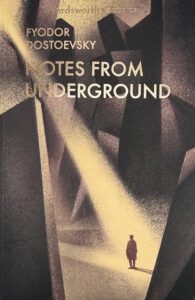
However, Notes from Underground is not good because it is pleasant, fast-paced, or easy to understand. The first half consists largely of a dense philosophical monologue in which the narrator argues with imaginary opponents, contradicts himself, and deliberately challenges the reader. The second half becomes more narrative, showing episodes from his past that reveal how his pride, resentment, and need for approval gradually pushed him further into isolation.
The Underground Man is not designed to be admired. He can be cruel, petty, self-absorbed, and frustrating. Yet his habit of overthinking every interaction, imagining insults, avoiding vulnerability, and sabotaging opportunities for connection makes him disturbingly recognizable. Readers may dislike him while still recognizing smaller versions of his behavior in themselves.
This psychological honesty is one of the main reasons Notes from Underground remains so influential. The novel explores how intelligence can become a tool for self-deception, how excessive self-consciousness can prevent action, and why human beings sometimes choose suffering simply to prove that they cannot be reduced to predictable rational formulas.
Although it is a short classic, it requires patience. Readers looking for an action-driven plot or sympathetic characters may find it frustrating. Those interested in existential literature, free will, alienation, resentment, and self-sabotage, however, may discover one of Dostoevsky’s most unsettling and memorable works.
In this article, we will examine whether Notes from Underground is worth reading, what the book is about, why it is considered a literary classic, and which readers are most likely to appreciate its unusual narrator.
Is Notes from Underground Worth Reading?
Yes, Notes from Underground is worth reading because it offers an unusually honest examination of isolation, resentment, pride, and the ways people use intelligence to justify their own destructive behavior.
The book is especially powerful because Dostoevsky does not present these ideas through a heroic or admirable character. Instead, he forces readers to spend time inside the mind of a man who understands many of his own problems but repeatedly refuses to change. The Underground Man can explain his failures in remarkable detail, yet that awareness only gives him new ways to defend them.
This makes the novel feel surprisingly modern. His tendency to replay conversations, imagine hidden insults, seek approval while pretending not to care, and avoid action through endless analysis will be recognizable to many contemporary readers. Notes from Underground shows that self-awareness does not automatically produce wisdom or improvement.
The novel is also worth reading for its philosophical challenge. The Underground Man rejects the idea that human beings will always choose whatever is rational, comfortable, or beneficial. He insists that people may knowingly choose pain, humiliation, or failure simply to demonstrate that they are free.
Dostoevsky does not offer this argument as a simple lesson. The Underground Man’s defense of free will is provocative, but his life also reveals what happens when freedom becomes an excuse for cruelty, passivity, and self-sabotage. Readers are left to decide which of his criticisms are insightful and which are merely rationalizations.
Who Will Enjoy Notes from Underground?
Notes from Underground will appeal most to readers who prefer ideas, psychological conflict, and difficult characters over action-driven plots.
The book is particularly suitable for people interested in:
- psychological fiction and unreliable narrators;
- existential literature and philosophical classics;
- stories about alienation, loneliness, and resentment;
- the conflict between reason and free will;
- characters trapped by overthinking and self-sabotage;
- short books that reward slow reading and reflection.
Readers who enjoyed the alienation and emotional detachment found in Albert Camus may also recognize how strongly Dostoevsky influenced later existential literature. Our list of books like The Stranger includes Notes from Underground precisely because both works confront isolation, meaning, and the individual’s uneasy relationship with society.
However, the book may not satisfy readers looking for a sympathetic protagonist, constant action, a traditional romance, or a clearly organized philosophical argument. The narrator frequently repeats himself, changes his position, and addresses objections that exist only inside his imagination.
These qualities are intentional, but understanding that does not make them enjoyable for everyone. The novel is worth reading because of its discomfort, not despite it.
Is Notes from Underground a Good First Dostoevsky Book?
Notes from Underground can be a good first Dostoevsky book, but it is not necessarily the easiest introduction to his work.
Its greatest advantage is its length. Readers can encounter many of Dostoevsky’s central concerns—guilt, humiliation, pride, isolation, faith, freedom, and destructive ideas—without immediately committing to one of his enormous novels.
The Underground Man also anticipates later Dostoevsky protagonists. Like Raskolnikov in Crime and Punishment, he is intelligent, isolated, and dominated by theories that separate him from ordinary human relationships. Readers interested in that connection can continue with our review, Is Crime and Punishment Good?
The difficulty is that Notes from Underground begins with one of Dostoevsky’s most abstract and confrontational sections. A first-time reader may assume that all his novels consist of dense philosophical monologues, when his longer works usually contain broader casts, stronger plots, greater emotional variety, and more dramatic events.
For readers already interested in philosophy or psychological fiction, this book can be an excellent beginning. Those who prefer a more developed story may find Crime and Punishment more accessible, despite its greater length.
Our guide to the best books to start reading Fyodor Dostoevsky can help readers choose an entry point according to their interests, preferred length, and tolerance for philosophical difficulty.
Ultimately, Notes from Underground is worth reading not because it provides comfort or easy answers, but because it confronts readers with a mind that is intelligent enough to recognize its prison and too proud to leave it.

What Is Notes from Underground About?
Notes from Underground is about an unnamed former civil servant living alone in Saint Petersburg. Usually called the Underground Man, he describes himself as sick, spiteful, and unattractive before beginning a long argument about society, reason, freedom, and human nature.
Rather than following a conventional plot from beginning to end, the book is divided into two very different parts. The first presents the narrator’s ideas, while the second shows how those ideas influence his behavior around other people.
This structure is important because the Underground Man often sounds intelligent and persuasive when discussing philosophy. Once readers see him interacting with others, however, his theories become inseparable from his pride, insecurity, resentment, and self-sabotage.
Part One: The Underground Man’s Philosophical Monologue
The first part, commonly titled “Underground,” takes place when the narrator is around forty years old. Living in isolation, he addresses an imaginary audience and argues against the belief that human behavior can be completely explained through reason, science, or personal advantage.
According to the Underground Man, people do not always choose what is sensible or beneficial. Even when happiness can be calculated and guaranteed, a person may deliberately choose something harmful simply to prove that human beings still possess free will.
He resists the idea that society could become perfectly organized if everyone followed rational rules. To him, such a world would reduce people to predictable machines. Human beings need the freedom to make mistakes, reject comfort, and act against their own interests.
However, his argument is complicated by the way he lives. The Underground Man celebrates freedom, but he is trapped by his own thoughts. He values consciousness, yet his excessive self-awareness prevents him from acting. He criticizes people for behaving mechanically, while repeating the same destructive patterns in his own life.
The monologue is deliberately contradictory. The narrator makes a claim, imagines how readers might object, attacks that objection, and sometimes undermines his original position. This can make the first part difficult, but it also creates the impression of listening to a restless mind arguing against itself.
Part Two: The Events That Shaped His Isolation
The second part, usually titled “Apropos of the Wet Snow,” moves backward to several episodes from the Underground Man’s younger years. It has a more recognizable plot and shows him attempting to interact with former classmates, servants, strangers, and a young woman named Liza.
These encounters reveal the enormous distance between how the narrator imagines himself and how he actually behaves. He dreams of appearing intelligent, powerful, and dignified, but his obsession with how others perceive him repeatedly produces humiliation.
Small social incidents become major psychological battles. He spends excessive amounts of time planning confrontations, rehearsing speeches, interpreting gestures, and imagining revenge against people who may barely remember him.
His behavior around former schoolmates demonstrates his desperate need for acceptance. He wants to be included, yet he treats others with hostility and contempt. When he feels ignored, he responds by making himself even more unpleasant, creating the rejection he already expected.
Liza becomes the most important person in this part of the book. Their conversations expose the difference between discussing suffering as an intellectual subject and responding compassionately when another person becomes vulnerable.
Without revealing the conclusion, Liza offers the Underground Man an opportunity for genuine human connection. His reaction shows how deeply pride and self-sabotage have shaped him. He is more comfortable imagining himself as rejected than accepting the responsibility and vulnerability that real affection would require.
The second part therefore does more than provide examples of the narrator’s philosophy. It reveals the emotional consequences of living according to resentment, excessive self-consciousness, and a constant fear of humiliation.
Notes from Underground is not primarily about external events. It is about a man who understands his own suffering, explains it brilliantly, and still uses that understanding to avoid changing his life.
Why Is Notes from Underground Considered a Great Book?
Notes from Underground is considered a great book because it combines psychological realism, philosophical conflict, dark humor, and an unforgettable narrative voice in a remarkably short work.
Dostoevsky does not simply explain ideas about freedom, reason, isolation, and human behavior. He turns those ideas into a character whose entire life has been damaged by his inability to stop analyzing himself and the people around him.
The result is a book that feels both intellectually challenging and emotionally uncomfortable. Readers are not asked to agree with the Underground Man. They are asked to observe how intelligence, pride, resentment, and fear can become inseparable.
The Underground Man Is an Unforgettable Narrator
The greatest strength of Notes from Underground is its narrator. The Underground Man is bitter, intelligent, insecure, cruel, self-aware, and completely unreliable.
He speaks directly to the reader, anticipates criticism, changes his arguments, and attacks imaginary opponents. At times, he appears to understand human nature with remarkable clarity. Moments later, he uses that understanding to excuse his own behavior.
This contradiction makes him fascinating. He knows that he is behaving irrationally, but his awareness does not give him control. Instead, it becomes another source of pride. He almost treats his suffering as evidence that he is more intelligent and sensitive than ordinary people.
The Underground Man also wants two incompatible things. He wants to feel superior to everyone around him, but he desperately wants their recognition. He claims to despise society, yet he cannot stop thinking about how society sees him.
Because the story is told entirely through his perspective, readers must constantly decide whether his observations are insightful, dishonest, exaggerated, or all three at once. This makes him one of literature’s most memorable examples of an unreliable narrator.
The Book Explores Overthinking and Self-Sabotage
One reason Notes from Underground still feels modern is its portrayal of excessive self-consciousness. The Underground Man does not merely think before acting. He analyzes every possible interpretation until action becomes almost impossible.
He replays conversations, imagines future humiliations, creates elaborate speeches, and interprets minor gestures as evidence of disrespect. Instead of helping him navigate society, his intelligence traps him inside increasingly complicated explanations.
This produces a cycle of self-sabotage:
- He wants attention, friendship, or respect.
- He assumes that others will reject or humiliate him.
- He behaves defensively or cruelly.
- People respond negatively to his behavior.
- He treats their response as proof that his original suspicions were correct.
The Underground Man is therefore not simply a victim of isolation. He repeatedly creates the conditions that deepen it.
Dostoevsky’s insight is that people can understand their destructive patterns without escaping them. Self-knowledge is valuable, but it can also become another excuse when it is not accompanied by responsibility, humility, or action.

Its Defense of Free Will Remains Provocative
The philosophical heart of Notes from Underground is its argument about free will. The Underground Man rejects theories suggesting that people will always behave rationally once they understand their true interests.
He believes that a perfectly organized society would threaten human individuality. If every decision could be predicted through science, mathematics, or personal advantage, then freedom would become an illusion.
For this reason, he claims that people may knowingly choose pain, failure, or humiliation simply to prove that they are not machines. A person may reject what is beneficial because the ability to reject it feels more important than happiness itself.
This remains a provocative idea because it recognizes something uncomfortable about human behavior: people do not always pursue what is healthiest, safest, or most reasonable. Pride, anger, desire, fear, and the need for independence often influence decisions more strongly than logic.
However, Dostoevsky does not present the Underground Man’s position as an unquestionable truth. His defense of freedom is powerful, but his own life demonstrates how destructive freedom can become when it is separated from moral responsibility.
He refuses to be controlled by rational systems, yet he is controlled by resentment. He protects his independence, but loses the ability to form meaningful relationships. His philosophy preserves his freedom while making him miserable.
Liza Reveals the Human Cost of His Ideas
Liza is essential because she transforms the Underground Man’s theories into a moral test. Before meeting her, he can discuss suffering, dignity, and human weakness as abstract subjects. Liza forces him to respond to another person’s vulnerability in real life.
During their encounter, the Underground Man initially presents himself as insightful and emotionally powerful. He speaks about loneliness and the dangers of her situation, appearing to offer sympathy and guidance.
Yet his motives are not entirely compassionate. He enjoys the influence his words give him. By making Liza feel vulnerable, he briefly escapes his own sense of humiliation and becomes the stronger person in the conversation.
When she later approaches him with genuine concern, the balance changes. He is no longer controlling an intellectual discussion. He is being offered real compassion, and accepting it would require him to admit weakness.
His reaction reveals the human cost of his pride. The Underground Man can describe love and suffering, but he cannot accept tenderness without feeling threatened. He would rather damage a possible connection than allow another person to see him honestly.
Liza therefore prevents the book from remaining only a philosophical monologue. Through her, readers see that the narrator’s ideas do not merely make him unhappy. They also harm people who attempt to reach him.
The Novel Helped Shape Existential Literature
Notes from Underground is frequently associated with the development of existential literature because it focuses on freedom, alienation, personal responsibility, irrational behavior, and the individual’s conflict with society.
The Underground Man anticipates many later literary characters who feel disconnected from social expectations and uncertain about whether life can be governed by stable moral or rational systems.
His voice can be recognized in later works about isolated individuals who observe society from the outside while remaining unable to participate in it successfully. The book’s influence is especially visible in literature centered on absurdity, alienation, and unreliable first-person narration.
Readers interested in these themes may also enjoy our selection of books like The Stranger, which includes works exploring similar questions about isolation, meaning, and the individual’s relationship with society.
The novel also anticipates Dostoevsky’s later characters. Like Raskolnikov in Crime and Punishment, the Underground Man allows an abstract theory to separate him from ordinary human relationships. Both men possess intelligence and psychological depth, but their ideas become sources of pride, isolation, and suffering.
Our article Is Crime and Punishment Good? explores how Dostoevsky developed these concerns into a larger story about guilt, responsibility, and the possibility of moral transformation.
What makes Notes from Underground great is not that it provides a clear philosophical solution. Its power comes from turning a conflict about freedom and reason into the voice of a man who is simultaneously insightful and ridiculous, wounded and cruel, self-aware and incapable of change.

Is Notes from Underground Difficult to Read?
Yes, Notes from Underground can be difficult to read, especially during its first half. Its challenge does not come from length, but from the narrator’s dense arguments, abrupt changes of direction, repeated ideas, and constant contradictions.
The book is short, yet it often demands more concentration than much longer novels. Readers expecting a conventional story may feel disoriented because the opening pages contain very little action. Instead, the Underground Man speaks directly to an imaginary audience and argues about reason, freedom, suffering, and human nature.
This difficulty is intentional. Dostoevsky wants the reader to experience the narrator’s restless mind rather than receive a perfectly organized philosophical argument. The confusion reflects a man who cannot stop questioning himself, anticipating criticism, and revising what he has just said.
Why the First Part Can Feel Confusing
The first part can feel confusing because the Underground Man rarely develops an idea in a straight line. He introduces an argument, imagines how someone might challenge it, attacks that objection, and then sometimes contradicts his own position.
He also speaks with several emotional tones at once. He can sound confident, ashamed, sarcastic, defensive, and angry within the same passage. This makes it difficult to determine when he is being sincere and when he is attempting to provoke the reader.
Another challenge is the historical context. Some of his arguments respond to nineteenth-century theories suggesting that human behavior could be organized according to reason, science, and personal interest. Modern readers may understand the general conflict while missing the specific political and philosophical ideas Dostoevsky was criticizing.
The narrator’s repetition may also test a reader’s patience. He returns again and again to the same concerns:
- whether human beings are truly rational;
- whether suffering can be chosen voluntarily;
- whether excessive consciousness prevents action;
- whether freedom is more valuable than happiness;
- whether people can understand themselves without changing.
However, these repetitions are not meaningless. They show a man trapped inside the same mental patterns. He does not progress toward a solution because his inability to move forward is one of the book’s central subjects.
The second part is generally easier to follow because it contains conversations, social situations, and a clearer sequence of events. It also helps explain the first part by showing how the Underground Man’s ideas operate in his daily life.
How to Make the Book Easier to Understand
The best way to approach Notes from Underground is to avoid treating the first part like a textbook. The Underground Man is a fictional character, not a neutral philosopher presenting a perfectly consistent system.
Readers do not need to agree with every statement or fully resolve every contradiction. It is often more useful to ask what each argument reveals about the narrator’s personality, fears, pride, and desire for control.
A few reading strategies can make the book more accessible:
- Read slowly. A few pages at a time may be more effective than rushing through the monologue.
- Remember that the narrator is unreliable. His intelligence does not make every conclusion correct.
- Do not expect immediate clarity. Some ideas become easier to understand after the events of the second part.
- Pay attention to contradictions. They are part of the character rather than simple mistakes in the writing.
- Separate Dostoevsky from the Underground Man. The narrator’s opinions should not automatically be treated as the author’s final position.
- Consider rereading the first part. Its arguments often become clearer once the reader understands how the narrator behaves around other people.
The choice of translation can also affect the experience. Some English editions preserve the narrator’s rough, repetitive style more closely, while others use more modern and fluid language. A reader struggling with one version may find another translation easier to follow.
It is also helpful to accept that complete understanding is not required on the first reading. Part of the book’s appeal comes from its ambiguity. The Underground Man is convincing and absurd, insightful and dishonest, sympathetic and cruel at the same time.
Notes from Underground is difficult, but it is not inaccessible. Readers who approach it patiently and focus on the narrator’s psychology rather than searching for a single correct philosophical message will usually find the experience much more rewarding.
Final Verdict: Is Notes from Underground Good?
Yes, Notes from Underground is a very good book and one of Fyodor Dostoevsky’s most important works. Its psychological depth, philosophical conflict, dark humor, and unforgettable narrator make it far more powerful than its short length might suggest.
The novel is especially successful as a portrait of resentment and self-sabotage. The Underground Man understands many of his own weaknesses, yet he turns that awareness into another reason to remain bitter, inactive, and isolated. His intelligence does not rescue him. Instead, it helps him construct increasingly sophisticated excuses for avoiding responsibility and human connection.
The book also remains relevant because its central questions have not disappeared. Are people truly rational? Is freedom still meaningful if every beneficial decision can be calculated in advance? Why do individuals sometimes reject happiness, intimacy, or success even when they understand the consequences?
Dostoevsky does not provide easy answers. The Underground Man’s defense of free will can sound insightful, but his behavior also demonstrates the danger of using freedom as permission for cruelty, pride, and deliberate misery.
However, Notes from Underground will not appeal equally to every reader. The first part is abstract, repetitive, and deliberately contradictory. The narrator is often unpleasant, and the story offers less action than readers may expect from a conventional novel.
For readers who enjoy psychological fiction, unreliable narrators, philosophical classics, and stories about alienation, the book is absolutely worth reading. Those who prefer fast plots, sympathetic protagonists, or clearly organized arguments may find it frustrating.
Notes from Underground is not great because it is comfortable. It is great because it forces readers to remain inside the mind of someone who recognizes his own prison, understands how it was built, and still refuses to leave it.
Readers who want to explore more of the author’s work can consult our guide to the best Fyodor Dostoevsky books, which presents several of his most influential novels and explains why each one deserves attention.
Who Was Fyodor Dostoevsky?
Fyodor Dostoevsky was a Russian novelist, journalist, and philosopher born on November 11, 1821, in Moscow. He became one of the most influential writers of the nineteenth century through his intense explorations of guilt, faith, freedom, suffering, morality, and the hidden contradictions of human behavior.
His life strongly shaped his fiction. In 1849, Dostoevsky was arrested for participating in a literary discussion group that criticized the Russian government. He was sentenced to death, taken before a firing squad, and informed at the last moment that his punishment had been changed. He then spent several years in a Siberian prison camp followed by military service.

These experiences deepened his interest in psychological conflict, spiritual crisis, and the ways people respond to humiliation and suffering. They later influenced many of his most important books.
Notes from Underground was published in 1864, during the mature period of Dostoevsky’s career. The book introduced several ideas and character types that he would develop more fully in later novels, especially the isolated intellectual whose theories separate him from ordinary human relationships.
This pattern can also be seen in Raskolnikov, the central character of Crime and Punishment. Both men are intelligent, proud, and trapped by ideas that appear logical in theory but become destructive when applied to real life. Our review Is Crime and Punishment Good? explores how Dostoevsky expanded these themes into a larger story about guilt, responsibility, and redemption.
Among Dostoevsky’s best-known works are:
- Crime and Punishment;
- The Idiot;
- Demons;
- The Brothers Karamazov;
- Notes from Underground.
Dostoevsky died on February 9, 1881, in Saint Petersburg. His influence extends far beyond Russian literature, shaping later novelists, psychologists, theologians, and existential thinkers.
Although Notes from Underground is one of his shortest works, it remains essential because it captures many of the questions that defined his career: whether people truly understand themselves, whether freedom can become destructive, and whether intelligence alone is enough to overcome pride and isolation.

Leave a Reply