
Can you truly experience a literary classic in the time it takes to commute to work? On November 10, 2026, German audiobook publisher Argon Verlag put that question to the test with the launch of longstoryshort – Klassiker in 30 Minuten (“Classics in 30 Minutes”), a new audio series that uses artificial intelligence to condense classic works of literature into half-hour listening sessions. Designed to attract busy audiences who might otherwise never pick up a nineteenth- or early-twentieth-century masterpiece, the project immediately ignited a fierce debate across Europe’s publishing community. While the publisher frames the initiative as an accessible gateway to great books, critics, voice actors, and readers have pushed back—raising a fundamental question about AI classic literature audiobooks: when we compress a novel down to its bare plot, are we democratizing culture or hollowing out the reading experience itself?
How Argon Verlag’s 30-Minute AI Classics Work
Argon Verlag, a well-established Berlin-based audio publisher owned by the Holtzbrinck Publishing Group, debuted the Argon Verlag longstoryshort series with three public-domain works from the German-language canon:
- Professor Unrat (1905) by Heinrich Mann, the satirical novel that famously inspired the classic film The Blue Angel.
- Die Totenwacht (1894), a novella by Austrian writer Marie von Ebner-Eschenbach.
- Die Frau des Weisen (1898), a psychological novella by Viennese modernist Arthur Schnitzler.
Unlike unauthorized AI scraping projects that have drawn lawsuits across the creative industries, Argon Verlag structured its workflow around legal compliance and human oversight. According to reporting by German book-trade journal Börsenblatt, the publisher uses artificial intelligence models to condense the original public-domain texts before human editors review and refine the resulting scripts.
For the audio production, Argon Verlag combines proprietary tools with voice synthesis technology from ElevenLabs. Crucially, the synthetic voices are not unauthorized clones; they are licensed from professional human narrators who signed agreements and received compensation for the digital use of their vocal likenesses. Still, compressing a full-length novel like Professor Unrat—which runs well over 70,000 words—into roughly 30 minutes of spoken audio requires cutting more than 90 percent of the original text.
Gateway to Great Books or “Literary Fast Food”?
Following the release, Argon Verlag’s social media channels were flooded with skeptical and angry reactions from longtime audiobook listeners, translators, and authors. In follow-up coverage by Börsenblatt and international trade publication Publishing Perspectives, the publisher defended the series as an experiment aimed at reaching listeners who feel intimidated by the length or archaic language of canonical literature. In Argon Verlag’s view, a 30-minute introduction acts as a spark that could inspire curious listeners to seek out the unabridged editions later.
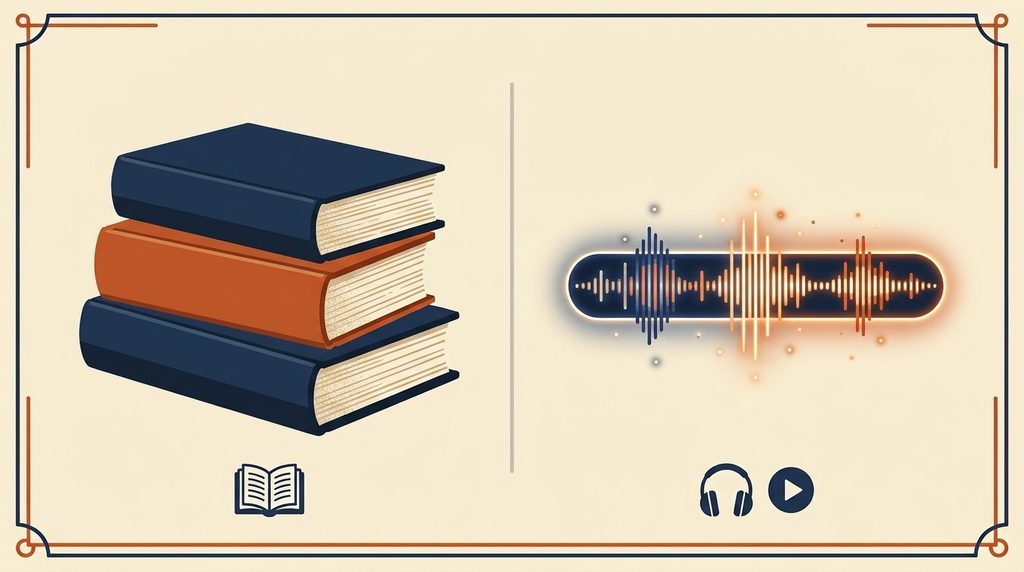
Many members of the literary community remain unconvinced. On Instagram and LinkedIn, commenters dismissed the concept as “literary fast food,” arguing that a publisher’s role is to champion depth and artistic integrity rather than surrender to shrinking attention spans. Voice actors and audiobook narrators—who hold a deeply respected cultural status in Germany’s mature Hörbuch market—also voiced concern that even licensed synthetic voices risk gradually eroding studio work and stripping away the emotional nuance that human performers bring to fiction.
Plot Summary vs. Literature: What Gets Lost in Condensation
Abridging books is hardly a new invention. Twentieth-century readers had Reader’s Digest Condensed Books and Classics Illustrated comic adaptations, while modern professionals routinely turn to apps like Blinkist for 15-minute nonfiction takeaways. Yet literary scholars have long drawn a sharp line between creative adaptation and mechanical reduction.
In her influential study A Theory of Adaptation, literary theorist Linda Hutcheon explains that a meaningful adaptation is an act of deliberate reinterpretation—a creative dialogue with a source text that transforms it into a new artistic work. By contrast, algorithmic condensation treats a novel primarily as a delivery system for plot points. When AI strips away 90 percent of Heinrich Mann’s prose or Arthur Schnitzler’s psychological interiority, what remains is a synopsis, not the artwork itself. In great literature, rhythm, irony, digression, and sentence structure are not obstacles standing between the reader and the story; they are the story.
There is also a cognitive dimension to the debate over deep reading vs summaries. Neuroscientist and literacy researcher Maryanne Wolf, author of Reader, Come Home, has shown that immersive, sustained reading activates neural circuits linked to critical analysis, empathy, and nuanced reflection—capacities that weaken when we train our brains to consume only bite-sized information. Listening to a 30-minute summary may tell you what happens to Professor Unrat, but it cannot replicate the slow immersion that allows a classic novel to challenge how you think and feel.
Read Next on Reader Habitat
If this debate made you think about the future of technology, human creativity, and why timeless books still matter, explore these related articles from our library:
- Is The Count of Monte Cristo a Good Book? Why This 1,000-Page Classic Still Captivates Readers — Intimidated by long classics? Discover why Alexandre Dumas’s sprawling masterpiece proves that patience and immersion deliver an unforgettable payoff no 30-minute summary could ever replicate.
- 10 Best Books Like Brave New World — From E. M. Forster’s prophetic short classic The Machine Stops to Kurt Vonnegut’s Player Piano, explore gripping dystopian novels that warned us decades ago about trading human depth for technological convenience.
- Is Notes from Underground Good? — Step inside Fyodor Dostoevsky’s razor-sharp psychological classic—a fierce critique of pure rationalism and mechanical efficiency that feels remarkably urgent in the age of artificial intelligence.
Conclusion: A Map Is Not the Journey
Argon Verlag’s experiment with 30-minute classic books highlights a growing tension across global publishing: how to keep timeless literature visible in an attention economy dominated by short videos, podcasts, and instant summaries. Used transparently as a study aid or a preview, a short audio overview has practical value. The danger lies in confusing familiarity with a plot for the experience of reading literature. A 30-minute summary can serve as a useful map—or an inviting doorway—but sooner or later, experiencing a classic still requires stepping inside and spending time with the author’s full voice.